No, most stick vacuums do not need a HEPA filter
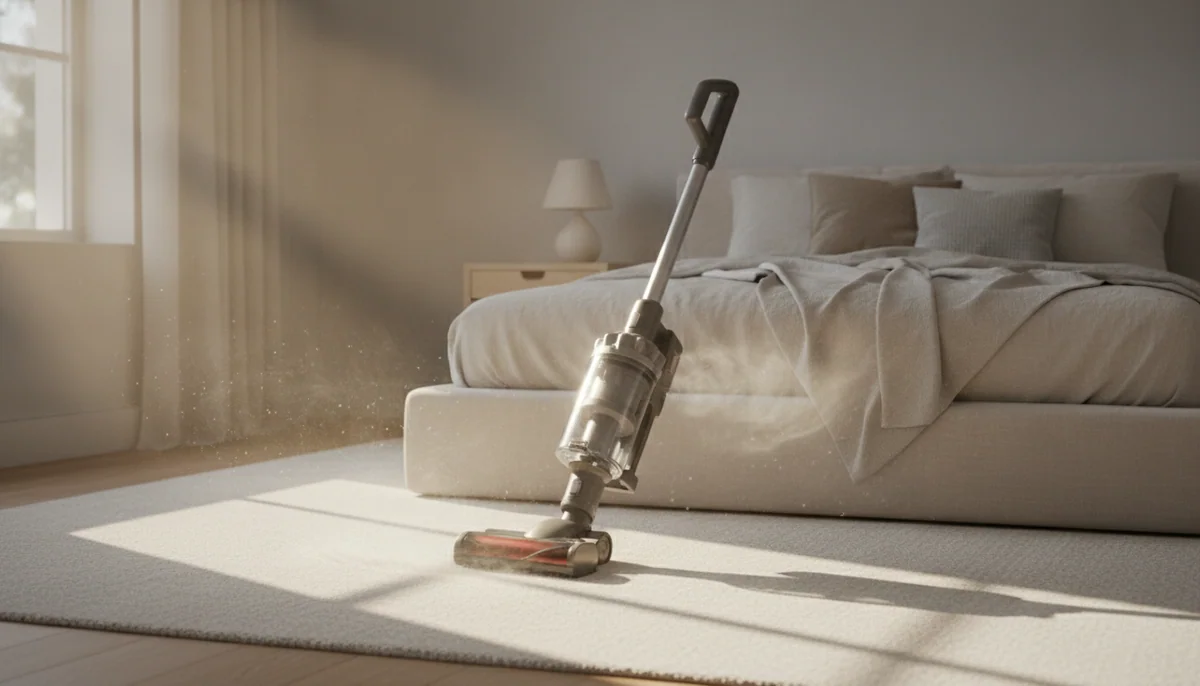
A vacuum has two jobs that advertising likes to blur together. It must remove dirt from the floor, and it must keep the finest part of that dirt from escaping through its exhaust, joints or dust bin. A HEPA filter can help with the second job. It cannot rescue a floorhead that leaves grit in carpet, a leaking body or a cup that throws dust back into the room when opened.
That is why the answer is not simply “HEPA is better.” For routine crumbs, visible pet hair and tracked debris in a household without serious dust sensitivity, a well-matched stick vacuum with ordinary filtration can be perfectly useful. If vacuuming provokes symptoms, someone in the home has asthma or significant allergies, or the machine regularly handles fine dust, containment becomes a primary buying requirement rather than a bonus specification.
The phrase to look for is not merely HEPA filter. Look for a credible claim about the complete machine, a particle size, a named test method where available and evidence that air cannot bypass the filter through the bin, seals or exhaust path. Dyson’s V11 Origin listing, for example, describes whole-machine filtration and attaches its percentages to particles as small as 0.3 microns, which is substantially more informative than a bare HEPA badge.
Choose independently supported whole-machine containment when fine dust, allergies or asthma make recirculated particles a meaningful concern.
Choose for pickup, floor compatibility and ease of use first when the vacuum will mainly collect visible debris in a household without unusual dust sensitivity.
The filter is only one border crossing
Dirty air does not politely report to the filter and wait for inspection. It travels through the floorhead, wand, cyclone or separator, bin, motor housing and exhaust. Every connection along that route is a possible bypass. A high-efficiency filter fitted to a poorly sealed vacuum can capture particles that reach it while letting other air escape around it.
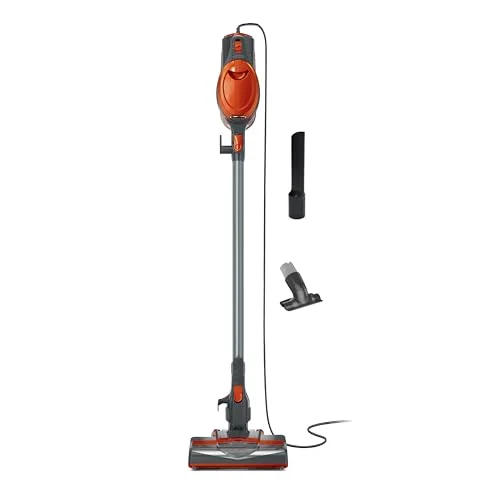
This distinction explains why an emissions test can be more revealing than a component list. The Shark Rocket HV301 has washable filters, yet it has no supported HEPA or sealed-allergen claim, and controlled testing found poor fine-particle containment. It remains useful on hard floors, rugs and stairs, but Cord Edge would not recommend it to a buyer whose main objective is allergen control.
The Bissell Featherweight 2033M makes the same point even more starkly. Its central fabric filter catches ordinary debris, while controlled testing found poor fine-particle retention. Low weight and fast hard-floor pickup can still make it a handy electric broom, but neither virtue changes what comes out of the exhaust.
A machine built for allergy-sensitive cleaning needs to perform credibly at all four stages. A HEPA element addresses only the third. Weak pickup leaves material in the room, leakage lets air evade the media, and dusty disposal returns part of the captured load to the user.
When HEPA deserves veto power
Put filtration near the top of the list when vacuuming fine material is a frequent task or when someone in the household is particularly sensitive to airborne dust. In that situation, an unsupported label should be treated as a failed requirement, not as a small uncertainty that stronger suction can offset.
Pet ownership alone does not settle the question. A brushroll can be excellent at lifting visible fur while the vacuum remains poor at containing finer material. The useful distinction is between hair pickup and allergen containment: they are separate capabilities, and the word “pet” on a listing proves neither sealed filtration nor freedom from hair wrap.
For everyone else, making HEPA mandatory can narrow the field without improving the cleaning that matters most. A hard-floor apartment may benefit more from a light machine that is easy to fetch, a head that does not scatter cereal and a battery that completes the usual route. A carpeted home may need strong agitation and sealed floorhead suction before another percentage on the filter becomes meaningful. Our guide to how stick vacuums handle carpet addresses that first part of the cleaning problem.
| Household or task | Filtration priority | What must accompany it |
|---|---|---|
| Significant dust sensitivity, allergies or asthma | Essential | Verified whole-machine containment, well-fitting filters and a low-exposure emptying routine. |
| Frequent fine dust or powder | High | A credible particle-size claim, good seals and filters that remain obtainable. |
| Pets without a dust-sensitive person | Situational | Strong hair pickup, a manageable brushroll and a bin that does not clog with fur. |
| Routine crumbs on hard floors | Secondary | Reliable pickup, low scatter, useful reach and a machine light enough to use frequently. |
| Deep cleaning substantial carpet | Important but insufficient | Effective agitation, floorhead suction and enough usable runtime or cord reach to finish. |
Four labels that should slow you down
“HEPA filter”
This identifies a component, not necessarily the performance of the assembled vacuum. Ask whether the complete airflow path is sealed and whether containment was measured with the filter installed in the machine.
“99.99% filtration”
A percentage without a particle size, test standard or description of what was tested is frustratingly incomplete. It may describe filter media in isolation rather than dust escaping from the working vacuum.
“Washable filter”
Washability describes maintenance, not filtration efficiency. A washable foam or fabric filter can be convenient and still offer poor fine-particle containment.
“Hygienic emptying”
A bottom door keeps fingers away from debris, but opening a bagless cup can still release dust and compacted hair may need encouragement. Disposal deserves its own evidence.
The iXlion TV109S illustrates why the details matter. Its listing advertises dual HEPA filtration, a sealed design and capture of up to 99.99% of fine dust and pet dander, but it supplies no particle size, named protocol or independent complete-machine leakage result in the retained evidence. The filter may be useful, yet the percentage is not enough to justify an allergy-first recommendation.
What a convincing claim looks like
Start with the exact model, not a brand-wide promise or a result borrowed from a similar vacuum. Retailers sometimes pool reviews and manufacturers reuse family names across machines with different filters, docks and accessory bundles. A test of one sibling can provide context, but it does not certify another.
“Advanced filtration” or a layer count without a particle size, seal claim or test method.
A HEPA-labelled filter plus an explicit claim that the machine’s airflow path is sealed.
A whole-machine capture percentage tied to a stated particle size and named test method.
The exact-model claim supported by independent emissions or leakage testing and a practical low-dust disposal system.
Also inspect the ownership details that preserve filtration after the first month. The filter must fit correctly, replacements must be identifiable, washable pieces need enough drying time, and seals must remain intact. A damp, damaged, clogged or poorly fitting replacement filter can undermine both airflow and containment. A washable part is useful only if the vacuum can remain out of service while it dries or a verified spare is available.
Bagless emptying remains the awkward exception to otherwise excellent operational filtration. Open the cup low inside a trash bag or empty it outdoors if dust exposure matters. If that routine still provokes symptoms, a bagged machine may solve the disposal problem more directly than another bagless stick with a stronger filter claim.
Two stick vacuums that make a stronger case
The Dyson V11 Origin is the straightforward option in this catalogue. Its exact listing makes a whole-machine claim tied to particles as small as 0.3 microns, and the site’s retained review found supportive emissions evidence for the broader V11 platform. The drawbacks are substantial: it is hand-heavy, requires the trigger to be held and still exposes the user to dust when its bagless bin is emptied.
The Shark IW4624 addresses the disposal problem more directly by emptying the stick into a freestanding dock. Shark claims that the vacuum and base capture more than 99.97% of dust and allergens down to 0.3 microns under ASTM F1977, but its separate “1,000 times less dust exposure” claim applies narrowly to an emptying-plume comparison against one manually emptied Shark upright. It is evidence for reduced contact during disposal, not proof that every part of cleaning is 1,000 times cleaner.
The dock does not abolish maintenance. Both the stick and base contain filters and airways, the bagless base eventually needs emptying, and narrow passages can clog. Choose it because automatic emptying will change how often you clean and how often you handle the small cup, not because the word “automatic” makes dust disappear.
Neither machine is automatically the best stick vacuum for every home. Buyers who do not need allergy-focused containment should compare the wider field in Cord Edge’s stick vacuum and electric broom recommendations, while dust-sensitive buyers should keep the filtration standard firm and compromise elsewhere.
A five-minute check before you buy
- Confirm the exact model: make sure the filtration statement applies to the actual model number and bundle.
- Find the tested particle size: do not let a percentage float free of the particles it supposedly describes.
- Look for whole-machine language: a filter-media result does not account for leaks around bins, joints or exhausts.
- Investigate emptying: decide whether a small bagless cup, auto-empty dock or another disposal design suits the user’s sensitivity.
- Check replacement support: identify genuine compatible filters and read the cleaning and drying instructions before committing.
- Return to the floor: verify that the vacuum can actually clean the surfaces, debris and area for which it is being bought.
Most shoppers can treat HEPA as a welcome secondary feature, not an admission ticket. Buyers managing meaningful dust sensitivity should do the opposite: insist on credible whole-machine containment, scrutinize disposal and walk away from vague percentages, however attractive the rest of the vacuum may be.
Frequently Asked Questions
Is a HEPA filter necessary in every stick vacuum?
No, it is most important for dust-sensitive households, while many other buyers will gain more from better pickup, floor compatibility and ease of use.
Does a HEPA filter mean the entire vacuum is sealed?
No, air can bypass an efficient filter unless the bin, joints, housing and exhaust route form a credibly sealed system.
Is a washable vacuum filter automatically HEPA-rated?
No, washability describes how a filter is maintained rather than how efficiently the complete vacuum contains fine particles.
Does 99.99% filtration prove that a stick vacuum is good for allergies?
No, the claim needs a particle size, a clear test scope and credible whole-machine evidence before it supports an allergy-focused recommendation.
Can a bagless HEPA stick vacuum release dust while being emptied?
Yes, opening the cup can create exposure even when the machine contains fine particles well during operation.
Is pet hair pickup the same as allergen filtration?
No, a vacuum can lift visible fur exceptionally well while leaking finer material or releasing dust during disposal.