Dyson V11 Origin vs V15 Detect Plus: the V15 wins on floors, not comfort
Choose the Dyson V15 Detect Plus for a hard-floor or genuinely mixed-floor home, but buy the V11 Origin instead when carpet and pet-hair cleaning matter more than illuminated dust, automatic power adjustment and battery swapping.
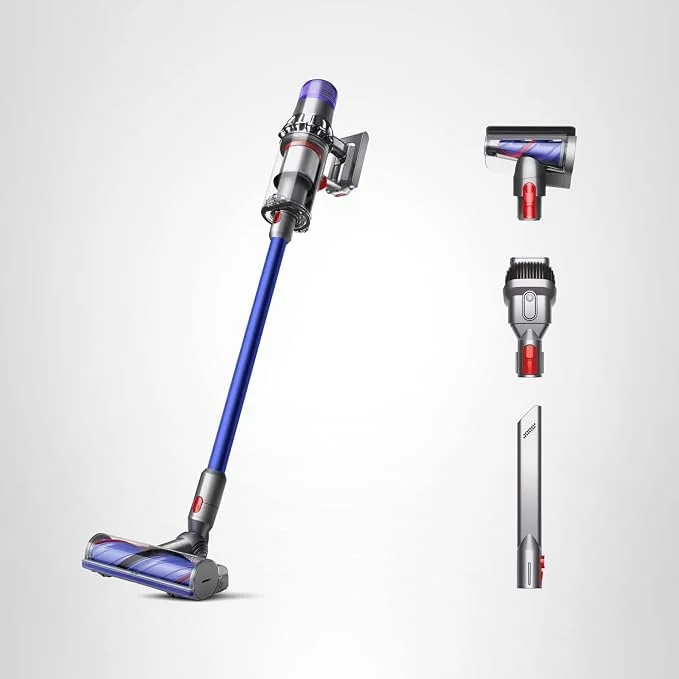
Dyson V11 Origin
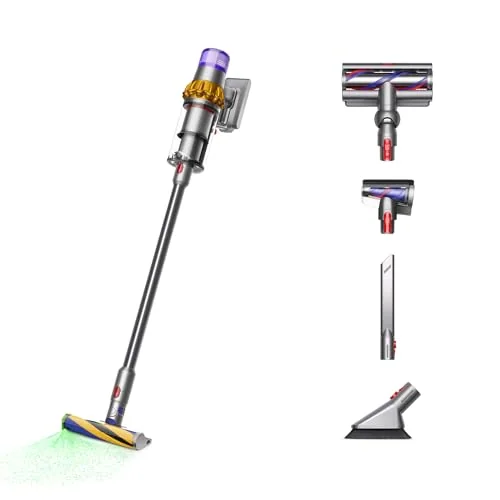
Dyson V15 Detect Plus
The Dyson V15 Detect Plus is the winner, although not because 240 air watts automatically defeats 185. It wins because the Fluffy Optic head gives hard floors their own carefully designed cleaner, the piezo sensor makes Auto mode genuinely adaptive, and its click-in battery is easier to replace or supplement. Those are useful ownership differences, not dashboard theatre.
The V11 Origin makes the comparison uncomfortable for the newer machine by getting the essential cleaning work so right. It is already a formidable carpet vacuum, handles pet hair convincingly, includes the Hair Screw tool and can run long enough in sensible modes to cover many ordinary homes. Independent comparison work has found the two platforms remarkably close in overall pickup despite the V15’s larger published suction figure.
Neither model fixes Dyson’s most persistent ergonomic irritations. Both place the motor, bin and battery near the hand, both require continuous pressure on a trigger, neither stands unsupported, and both can become awkward when strong suction seals a cleaner head against dense carpet. The V15 also introduces a new inconvenience: its signature illumination belongs only to the separate hard-floor head, so using its full capability in a mixed-floor home means changing heads.
That leaves a clean dividing line. The V15 is worth pursuing when seeing fine dust on bare floors will change how you clean, when automatic suction control has practical value, and when battery removability matters over years of ownership. The V11 is the sharper choice when you mainly need a premium cordless to pull debris and hair from carpet without paying for a second floorhead and sensor system that will spend much of the week unused.
Pick the V15 Detect Plus
Choose it for substantial hardwood, tile or laminate, a mixture of hard flooring and carpet, visible fine dust, a removable battery and the most capable two-head system in this comparison.
Pick the V11 Origin
Choose it for carpet-led cleaning, pet hair, conventional whole-home pickup and a simpler package whose missing detection features will not be missed.
At a Glance
| Feature | Dyson V11 Origin Cordless Vacuum, 185AW, 3 Power Modes, Up to 60 Minutes,² Deep Cleans Hard Floors and Carpets, Detangles pet Hair, Converts to Handheld | Dyson V15 Detect Plus Cordless Vacuum, Illumination Reveals dust, 240AW, 3 Power Modes, Up to 60 Minutes,² Deep Cleans Hard Floors and Carpets, Detangles pet Hair, Converts to Handheld |
|---|---|---|
| Price tier | Premium | Premium |
| Finish | Nickel/Blue | Yellow/Nickel |
| Check Price on Amazon | Check Price on Amazon |
The upgrade is a floor system, not a cleaning miracle
The V11 Origin uses one Motorbar cleaner head for carpet and hard floors. That makes room-to-room cleaning straightforward: leave the head attached, select an appropriate mode and keep moving. It is a strong generalist, particularly where carpet is the surface that exposes a weak vacuum.
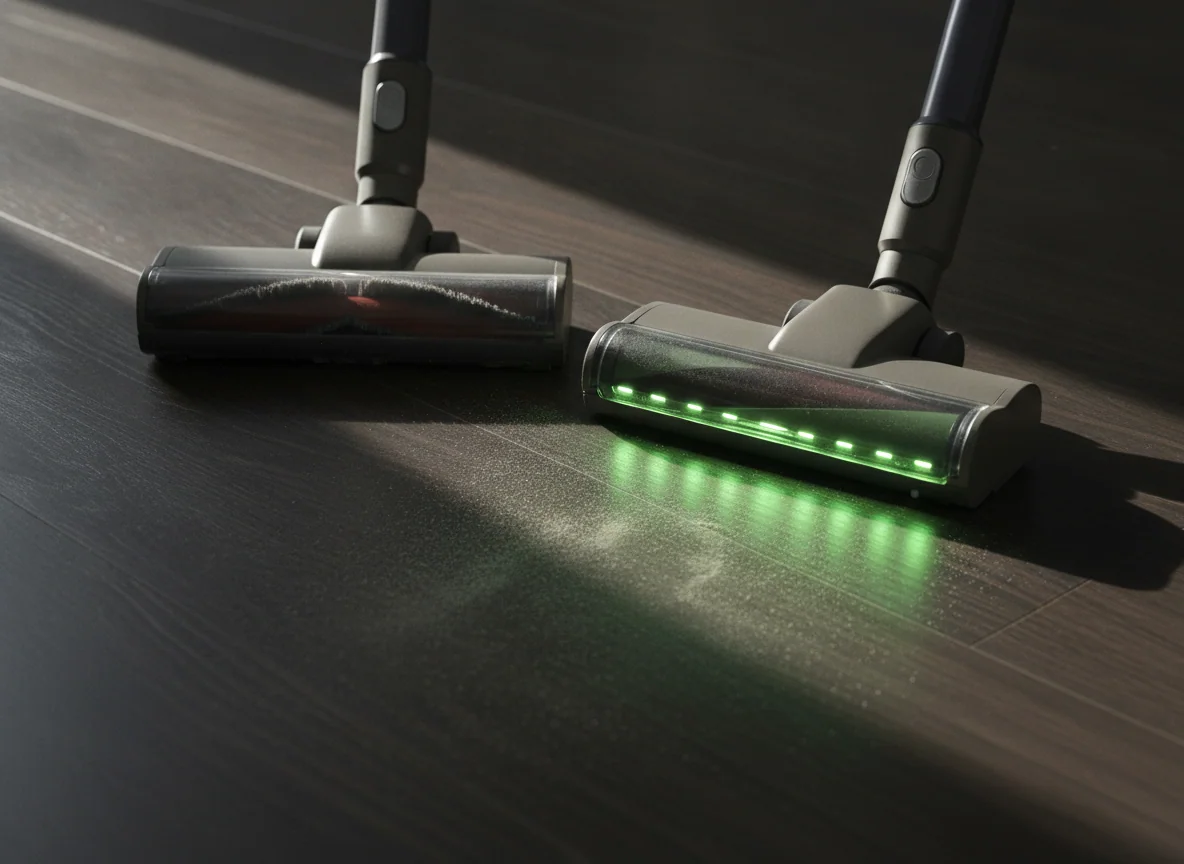
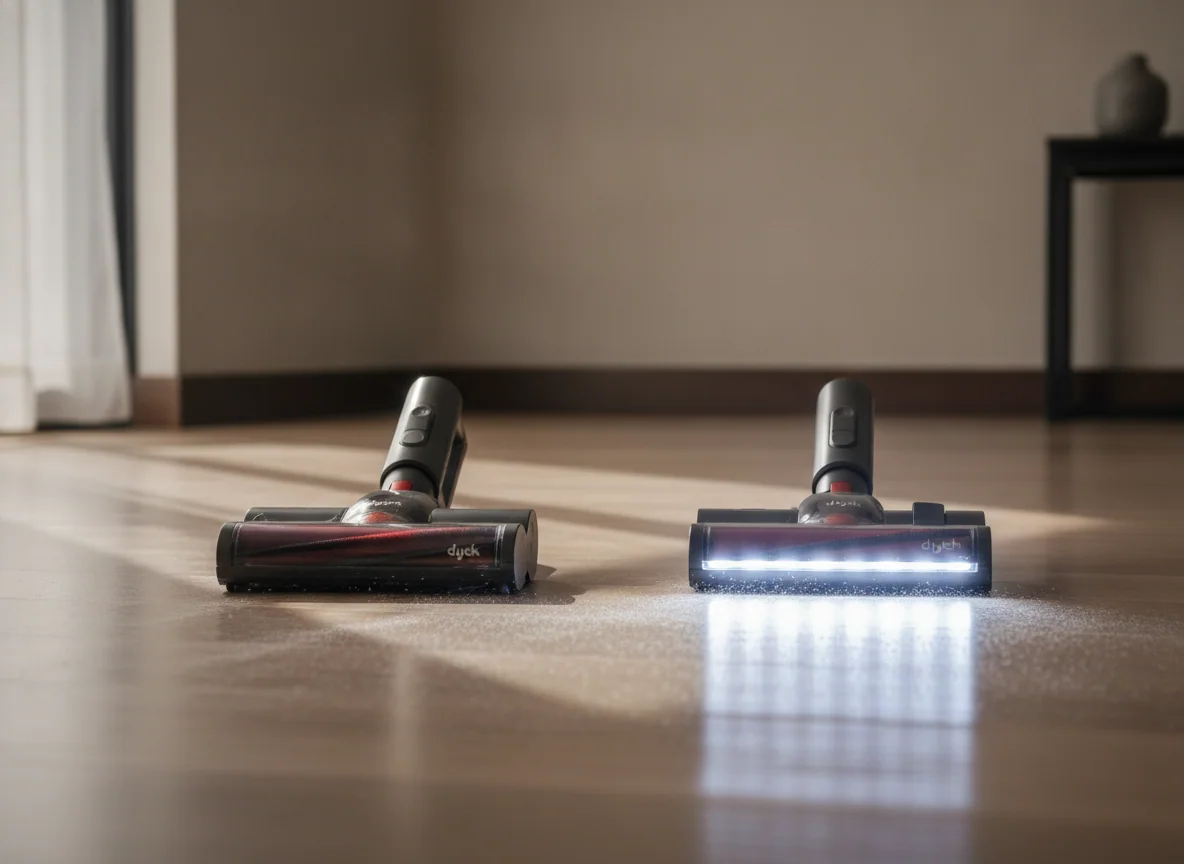
The V15 Detect Plus divides the work. Its Digital Motorbar is the carpet and mixed-surface head, while the Fluffy Optic head is a soft roller built specifically for hard flooring. Green illumination travels across the floor at a low angle, turning hairs and fine dust that ordinary overhead lighting misses into obvious targets. The soft roller also handles fine material and larger hard-floor debris more gracefully than a conventional bristled carpet head.
That specialized head is the clearest reason to buy the V15. The particle graph is not. Its piezo sensor still earns a place because Auto mode can change power in response to the debris entering the machine, but the colorful count on the LCD does not certify that a room is sanitized or objectively clean. It is feedback, not a laboratory report.
The V11’s screen has a more modest job and performs it well. It reports the selected mode, estimated runtime and maintenance alerts. Its Auto setting should not be confused with the V15’s debris-responsive system because the exact V11 Origin listing describes a balanced everyday mode without clearly promising the same automatic sensing behavior.
| Decision point | Dyson V11 Origin | Dyson V15 Detect Plus | What matters at home |
|---|---|---|---|
| Published suction | 185 air watts | 240 air watts | The V15 has more peak output, but floorhead design and usable settings matter more than the number alone. |
| Floorheads | Motorbar for carpet and hard floors | Digital Motorbar plus Fluffy Optic hard-floor head | The V11 is simpler between rooms, while the V15 is more specialized on each surface. |
| Dust illumination | None promised | Green illumination on the Fluffy Optic head | The advantage exists only on hard floors with that head attached. |
| Automatic response | Three modes with a balanced everyday setting | Piezo sensing and debris-responsive Auto mode | The V15 can add power over dirtier areas without leaving Auto. |
| Battery arrangement | One battery, with the exact connector type not clearly established | One removable click-in battery | The V15 offers the clearer route to replacement or an optional spare. |
| Maximum claimed runtime | Up to 60 minutes | Up to 60 minutes | Neither headline describes powered-head use in Boost. |
| Hair tools | Motorbar and Hair Screw tool | Digital Motorbar and Hair Screw tool | Both are strong choices for pet hair, although neither eliminates every tangle or blockage. |
| Power control | Trigger held while running | Trigger held while running | Neither is friendly to reduced grip strength. |
| Storage | Wall dock, no unsupported standing | Wall dock, no unsupported standing | Both need an installed dock or a safe place to lie flat. |
Carpet closes the specification gap
Both Dysons are credible primary vacuums for ordinary carpet rather than glorified sweepers. The V15 has the higher power ceiling and an adjustable gate on its Digital Motorbar, which helps manage large debris and the seal against carpet. Yet the V11’s established pickup remains strong enough that the difference in routine results can be much smaller than 240 versus 185 suggests.
Maximum power can make either machine less pleasant. A tight seal on deep pile increases pushing effort, and loose rugs can lift or catch under a rotating brush. Eco is often the more usable setting on an unsecured rug; Boost belongs on stubborn patches rather than across an entire carpeted floor. Readers working out whether this form factor can replace a full-size machine should see our guide to when a stick vacuum can replace an upright.
Hard floors give the V15 its decisive lead
The V11 Motorbar can collect ordinary dust, crumbs and litter from bare flooring without a head change, so it is not a carpet-only vacuum. Its weakness is finesse: light debris can scatter, larger pieces can be less graceful, and there is no promised illumination to expose the film along baseboards or beneath furniture.
The V15’s Fluffy Optic head solves those problems more directly. The soft roller is gentler and more accommodating on hard surfaces, while the light reveals the material it is about to collect. This is why the V15 wins for a mostly hard-floor home even if an ordinary pickup test makes the two motors look close. The current package promises two advanced cleaner heads, although buyers should still verify the exact attachment contents rather than borrowing assumptions from Absolute, Pro or Total Clean bundles.
Pet owners get two good answers
Both packages combine a powered main head with Dyson’s conical Hair Screw tool. The smaller tool is particularly useful on pet beds, carpeted stairs, sofas and car seats because its shape encourages strands toward the inlet instead of letting them wind around a straight miniature roller. V11 owners also report strong results with cat hair and tracked litter.
The word “detangling” still needs discipline. Long human hair can wrap around either main brush, and dense fur can compact in the bin or choke the inlet even when the roller looks clean. Empty before debris reaches the maximum line, inspect the full air path when suction falls, and expect occasional manual brush maintenance. Our explanation of what anti-tangle brush rolls can and cannot prevent applies to both machines.
Runtime is effectively a draw
Both listings advertise up to 60 minutes, and both attach conditions to that ceiling. Eco with a light tool gives the best chance of approaching it. Everyday powered-head cleaning is shorter, while Boost can consume a charge in roughly the time it takes to treat a few difficult areas. The V15’s Auto mode can ration power intelligently, but it does not turn the maximum claim into an all-settings promise.
A full recharge takes hours rather than a short break between rooms. The V15 provides the more flexible ownership path because its battery is removable and a second compatible battery can be acquired separately; no spare is established as part of this Plus package. The V11 listing includes one battery but does not clearly identify its connector as click-in, so its exact attachment should be confirmed before buying a replacement. For a fuller explanation, see how advertised cordless runtime changes in real cleaning.
Two premium vacuums with the same ergonomic debt
The V15 is newer and more intelligent, but it is not the comfort upgrade this comparison might imply. Both machines carry their heaviest components behind the hand. That balance is manageable during normal floor cleaning, yet it becomes tiring on stairs, upholstery and overhead work because the wrist supports the motor, bin and battery directly.
Continuous trigger pressure makes the problem more consequential. A buyer with arthritis, carpal-tunnel symptoms, reduced grip strength or an easily fatigued wrist should not choose either model on cleaning performance alone. The V15’s more elaborate floor system cannot compensate for a control arrangement that hurts during use.
Bagless emptying also remains imperfect. Both use a sliding ejector, but compacted hair may need help and fine dust can escape when the bin opens. Their filtration can contain fine particles well while the motor is running without making disposal a sealed process. Dust-sensitive buyers should empty outside or deep inside a bag and consider whether a bagged machine better fits the problem.
The stronger choice for hard floors and demanding mixed-floor homes
The V15 Detect Plus earns first place through its illuminated soft roller, responsive Auto mode, removable battery and excellent carpet and pet-hair capability.
Its held trigger, top-heavy body, dusty emptying and repeated floorhead swaps make an expensive vacuum feel less effortless than it should.
The smarter choice when carpet cleaning matters more than detection technology
The V11 Origin preserves strong conventional pickup, useful runtime information and the Hair Screw tool without making the V15’s sensors central to the purchase.
Its wrist-heavy body, continuous trigger, uncertain battery connector and lack of an illuminated hard-floor head reveal the age of the design.
Buy for the floors you own, not the specification you admire
A mostly hard-floor home
Buy the V15 Detect Plus. The Fluffy Optic head is the largest practical difference in this comparison because it both reveals and collects fine debris on hardwood, tile and laminate. The V11 can clean those surfaces, but it cannot recreate the visibility or soft-roller behavior with the package described here.
A mostly carpeted home
Favor the V11 Origin unless the V15’s removable battery or automatic debris response solves a specific problem. The V11 already has the cleaning force, Motorbar and pet tool that make a premium cordless useful on carpet, while the V15’s defining illuminated head may remain in storage.
Pets across carpet and furniture
Either model is defensible. The V15 is more versatile when shedding reaches hard floors as well as rugs, but the V11 retains the essential Motorbar and Hair Screw pairing. For alternatives beyond Dyson, our cordless pet-hair vacuum guide compares the wider field.
Weak hands or long staircases
Walk away from both unless you already know that the trigger and rearward balance are comfortable for you. A lighter machine may surrender peak suction while becoming far more usable for the jobs that place the entire body at the wrist.
One uninterrupted pass through mixed rooms
The V11 is operationally simpler because its Motorbar stays attached across carpet and bare flooring. The V15 can also cross surfaces with its Digital Motorbar, but doing so forfeits the illumination and soft-roller performance that justify buying it.
A V11 already in good condition
Keep it unless the illuminated head, debris-responsive Auto mode or removable battery answers a recurring frustration. Similar ordinary pickup makes particle counting alone a weak reason to replace a working vacuum.
The final call
The V15 Detect Plus is Cord Edge’s winner because it expands what the vacuum can do on hard floors without surrendering serious carpet and pet-hair cleaning. Its advantage is visible every time the Fluffy Optic head exposes a dusty edge or the Auto mode responds to a dirty patch.
The V11 Origin remains the recommendation with less glamour and considerable sense. Choose it when carpet is the harder surface in the home, when one general-purpose floorhead is preferable to swapping, and when the V15’s extra intelligence would mostly produce information rather than a better cleaning routine. Readers still unsure where either sits in the range can use our guide to choosing a Dyson stick vacuum.
How Cord Edge reached this verdict: Cord Edge did not handle or measure these units, and this comparison reconciles each exact package listing with the conclusions already established in our V11 Origin review, our V15 Detect Plus review and independent family-level comparison evidence.
Frequently Asked Questions
Does the V15 clean noticeably better than the V11?
The V15 is more capable on hard floors and has a higher power ceiling, but ordinary overall pickup can be remarkably close when both machines use an appropriate powered head.
Which model is better for hardwood floors?
The V15 Detect Plus is better because its illuminated Fluffy Optic head reveals fine dust and handles bare-floor debris more gracefully.
Which model is better for carpet?
The V15 has greater peak power, but the V11 Origin already cleans carpet strongly enough to be the more rational choice when illumination and debris sensing add little value.
Does the V11 Origin have the V15’s automatic dirt detection?
No equivalent piezo-based debris sensing is clearly promised for this exact V11 Origin, whose Auto setting is described as a balance of power and runtime.
Does the green light work on carpet?
No, the V15’s illumination belongs to its dedicated Fluffy Optic hard-floor head and is unavailable when the carpet-oriented Digital Motorbar is fitted.
Do both vacuums run for a full hour?
Both can approach their 60-minute claims only under favorable low-power conditions, while powered-head use and Boost shorten runtime substantially.
Which Dyson is better for pet hair?
Both are strong pet-hair choices with powered floorheads and Hair Screw tools, although the V15 is more versatile when shedding spreads across substantial hard flooring.
Can either vacuum stand upright by itself?
No, both require a wall dock, another secure support or a safe place to lie flat.
Do both models require the trigger to be held?
Yes, both require continuous trigger pressure while running, which can be a decisive limitation for buyers with hand or wrist problems.
Is the V15 battery easier to replace?
Yes, the V15 uses a removable click-in battery, while the exact connector arrangement on this V11 Origin should be confirmed before planning around a spare.
Should a current V11 owner upgrade to the V15?
Upgrade only when hard-floor illumination, adaptive Auto mode or the removable battery solves a real need because particle data alone does not justify replacing a healthy V11.
Is the V15 Detect Plus the same as the V15s Detect Submarine?
No, the V15 Detect Plus is a dry vacuum and cannot be turned into the separately programmed V15s wet-cleaning model by adding a Submarine head.