Most homes need a vacuum with a brush roll
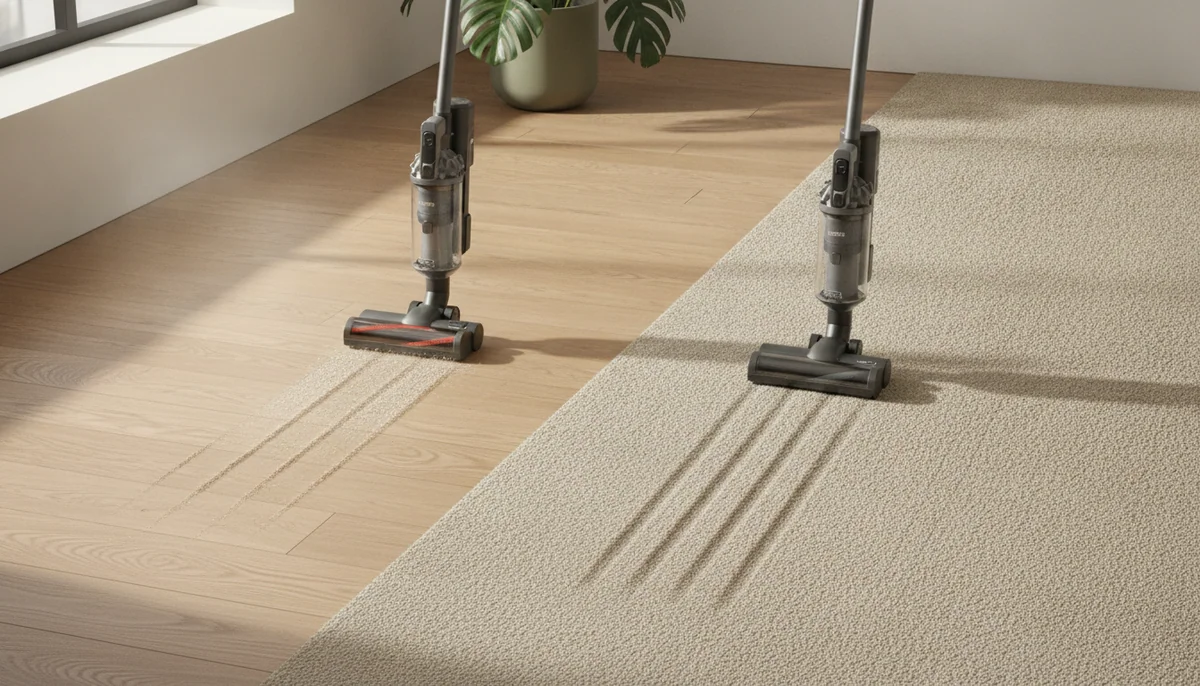
A brush roll is not a decorative cylinder added to make a vacuum look busy. It combs through carpet fibers, loosens grit and lifts hair so airflow can carry the material into the bin. Straight suction can collect what is already exposed, but it cannot perform that agitation. For most buyers choosing one vacuum for the home, that difference settles the decision.
Suction-only machines still have a legitimate purpose. On tile, vinyl, laminate and wood, crumbs and loose fur do not need to be excavated from a pile. A light nozzle can simply pull them from the surface. Removing the roller also removes hair wrap, a drive belt, a brush motor and the chance that fast bristles will scatter light debris. The result can be an excellent electric broom.
The mistake is buying that broom for a carpet problem. A brushless head can make the top of a rug look tidy while hair and fine grit remain below. One long-term Eureka Blaze owner thought the machine had collected shedding hair from a low-pile rug until tape revealed that the strands were still embedded in it. The vacuum had removed the visible evidence, not the underlying mess.
Choose a powered brush roll
Carpet, rugs, pet hair pressed into fabric and the expectation that one machine should clean the whole home all justify powered agitation.
Choose suction only
Mostly hard flooring, loose daily debris, low lifting effort and freedom from roller maintenance can make a simple brushless electric broom the smarter tool.
The carpet decides before the motor does
Buyers are often drawn into comparisons of watts, volts, air watts and kilopascals before checking the part that touches the floor. That order is backwards. Suction and airflow matter, but a floor head determines how effectively they reach the dirt. A modest motor attached to a well-sealed nozzle can collect exposed debris convincingly, while a stronger motor still cannot make an unpowered head comb carpet.
Picture carpet as a loose fabric rather than a flat surface. Foot traffic pushes grit between fibers, hair catches across several strands and fine dust settles below the visible tips. Air passing over the top may lift crumbs and lint, but agitation bends and separates the pile so buried material can enter the airflow. This is why a vacuum can leave satisfying lines in carpet without necessarily extracting everything, and why a brushless pass can look successful without being complete.
Controlled testing of the basic Bissell Featherweight illustrates the limit. Its narrow straight-suction opening can seal tightly enough to perform well over crevices and collect small debris from hard flooring, yet its low-pile carpet performance suffers from almost no agitation, narrow pickup and extremely poor pet-hair removal. Hair can be pushed into the fibers rather than lifted from them.
More motor power does not cancel that distinction. The Eureka Blaze produced strong airflow for an inexpensive electric broom and recovered much of the exposed test material in staged comparisons, but it still lacked the carpet agitation supplied by a powered Shark used beside it. Its success proves that straight suction can be remarkably effective within the right job, not that the two floor-head designs are interchangeable.
Judge suction-only heads by what they remove from a surface and powered heads by how well they reach into it.
Hard floors make the choice genuinely interesting
A bare floor changes the physics and the recommendation. Dirt has nowhere deep to hide, so direct suction can collect dust, crumbs, litter and loose hair without first disturbing a carpet pile. A brushless nozzle is often quieter mechanically, lighter and easier to maintain. Long strands cannot wrap around a roller that does not exist.
Simplicity can also protect the cleaning routine from its owner. There is no brush chamber to open, no belt to replace and no packed collar of hair to cut from a spindle. In homes where shedding hair drifts across hard flooring but rarely reaches carpet, that can be a better answer than buying an elaborate anti-tangle system. The vacuum collects the hair instead of managing it after the roller has already captured it.
Straight suction has its own nozzle problems. A low, tightly sealed opening may snowplow cereal or refuse coarse pieces that sit taller than its front gate. A wide capture slot can admit larger crumbs but leak enough air to weaken cleaning at edges and crevices. Lightweight rugs may lift under suction, and cheap swivel joints can turn when the user wants the head to track straight. Removing the roller simplifies the head; it does not guarantee that the remaining head is well designed.
| Cleaning job | Better starting point | Reason |
|---|---|---|
| Dust, crumbs and loose fur on hard floors | Suction only | Exposed debris does not require agitation, and there is no roller to wrap hair. |
| Low-pile carpet with ordinary tracked dirt | Powered brush roll | Agitation reaches below the visible surface instead of merely tidying it. |
| Pet hair embedded in carpet | Powered brush roll | Bristles or fins separate fibers and lift strands into the airflow. |
| Long loose hair on tile or wood | Suction only | A brushless head avoids roller wrap without sacrificing the agitation that a bare floor does not need. |
| Thick carpet or shag | Powered head with suitable adjustment | Agitation is necessary, but excessive sealing or the wrong height can make the head difficult to push. |
| Delicate or unsecured rug | Depends on the rug | Straight suction can lift the fabric, while a powered roller can grab edges, tassels or loose weave. |
| One vacuum for mixed flooring | Powered brush roll | It preserves carpet capability, ideally with a slower mode, brush control or a separate hard-floor head. |
Mostly hard-floor homes should therefore ask a more precise question: is this machine replacing a broom or replacing the main vacuum? A brushless stick is compelling in the first role. In the second, it works only when carpet, upholstered pet hair and fine-dust containment are minor concerns. Cord Edge’s guide to electric brooms and stick vacuums explores that division in more detail.
A brush roll adds cleaning power and a maintenance bill
Powered agitation earns its recommendation, but it is not free. Hair can wind around the roller, migrate toward the end caps and tighten against bearings. Threads, rug tassels and charging cables can enter the chamber. A neglected roll may slow, stop or place extra load on its motor. Conventional rollers often require scissors and patient cutting after the mess has already reached the machine.
Anti-tangle combs, vanes and conical rollers can reduce that work. They do not abolish it. The current Dyson V8 Motorbar, for example, performed well on carpet and meaningfully reduced wrapping in controlled testing, while long strands could still gather at the ends. The correct promise is less hair maintenance, not a brush chamber that never needs inspection.
Thick and lightweight rugs create another complication. A powerful brush head may seal so tightly that pushing it becomes tiring, or its roller may grab a movable mat. Adjustable gates, suction modes and brush speeds help. A true brush-off control can be even better on delicate flooring, although many stick vacuums merely slow the roller rather than stopping it.
These drawbacks are real, but they do not overturn the carpet decision. Cutting hair from a roller is irritating; leaving dirt embedded in carpet is a failure to perform the job. Buyers with carpet should solve the maintenance problem by choosing a better roller design, not by removing agitation altogether. Our guide to anti-tangle vacuum brush rolls separates useful engineering from impossible promises.
Three kinds of buyer, three sensible machines
The cleanest way to shop is to start with the floor rather than the product tier. A hard-floor quick cleaner, a mixed-floor daily vacuum and a carpet-focused primary machine should not be judged by the same standard. The following choices send each design toward the work it actually performs well.
Choose the Eureka Blaze NES215A when you want a corded electric broom for hard floors.
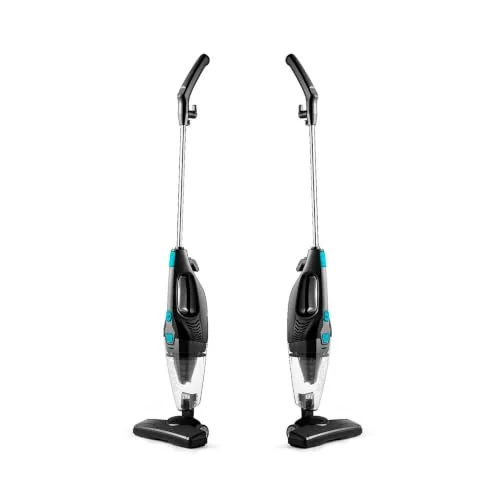
The Blaze is the strongest suction-only choice here for loose crumbs, grit and hair in a small, mostly hard-floor home because its light body and swivel head make daily pickup easy.
Its brushless nozzle cannot reliably extract embedded hair or deep dirt from carpet, and its basic filtration is not an allergy-control system.
The Blaze is the most coherent expression of the suction-only idea. It has no battery to age, no roller to unwrap and enough maneuverability to feel like more than a dustbuster on a pole. Its raised front opening also accepts larger loose debris more readily than the narrower Bissell Featherweight head in comparative testing.
That same comparison favored the Eureka for general pickup and steering while finding the Bissell stronger over a crevice because its nozzle leaked less air. Neither machine belongs in a carpet-heavy home. Read the full Bissell Featherweight and Eureka Blaze comparison if extreme lightness matters more than the Eureka’s swivel head.
Choose the Dyson V8 when easy handling matters more than flagship specifications.
The V8 is the practical powered-roll choice for a small mixed-floor home, stairs, upholstery and routine pet hair because it combines credible carpet agitation with a compact cordless body.
Max mode lasts only minutes, recharging takes hours and the trigger must remain pressed throughout use.
The V8 is a useful step beyond an electric broom because its Motorbar can agitate carpet without turning the whole machine into an oversized flagship. The included Hair Screw tool also gives it a serious role on pet beds, upholstery and carpeted stairs. It is not the strongest cordless vacuum, but it is often the easier one to retrieve for a five-minute job.
The compromise is endurance. Regular mode should perform most of the cleaning, with Max reserved for stubborn patches rather than entire rooms. Large carpeted homes should move beyond the V8 or keep a corded primary vacuum. The full Dyson V8 review covers its runtime, battery and long-term ownership tradeoffs.
Choose the Dyson V11 Origin when carpet and pet hair are the reason you are buying.
The V11 Origin is the strongest balanced choice here for serious cordless carpet cleaning because its Motorbar, 185-air-watt rating and Hair Screw tool address both floor and upholstery hair.
Its rear-heavy body, continuously held trigger and strong seal can make long sessions or deep carpet tiring.
The V11 makes sense when the brush roll is not merely insurance for an occasional rug. Its carpet evidence is much stronger than that of inexpensive quick-clean sticks, and its larger bin, three modes and runtime display make it more credible as a primary cordless vacuum than the V8.
Strong suction can become an ergonomic problem on plush flooring, and the motor, battery and cup remain concentrated near the hand. Buyers who want this level of cleaning should accept that it is a capable machine rather than an effortless one. Cord Edge compares its power and weight directly in the Dyson V8 and V11 guide.
When a separate hard-floor roller is worth the trouble
Premium cordless vacuums sometimes avoid the compromise by providing two powered heads. A soft roller seals closely to hard flooring, accepts larger particles through a more open front and treats delicate finishes gently. A conventional bristled or finned head remains available for carpet. This is the most capable arrangement for a home with substantial amounts of both surfaces.
It is also less convenient than advertisements imply. The useful head is always the one currently stored elsewhere. Moving through rooms that alternate between rugs and hard flooring can mean repeated swaps, and a wall dock may not hold every piece. A general-purpose powered head is less specialized but simpler if the home changes surface every few steps.
Choose the Dyson V15 Detect Plus only when you will use both of its powered floor heads.
The V15 Detect Plus is the most complete mixed-floor choice because its illuminated soft roller excels on hard floors while the Digital Motorbar delivers genuine carpet agitation.
The premium design still requires head swapping, continuous trigger pressure and dusty bagless emptying, while its motor and battery remain heavy at the hand.
The green illumination is useful rather than theatrical because it exposes fine dust that overhead light misses, but it works only with the dedicated hard-floor head. Carpet receives the Digital Motorbar instead. Controlled testing supports excellent embedded-debris pickup, although Boost can seal aggressively to dense carpet and is far too short-lived for whole-home use.
The V15 is therefore an architecture purchase rather than a particle-counter purchase. Buy it when hard-floor visibility and serious carpet cleaning both matter enough to justify two heads. The V11 Origin and V15 Detect Plus comparison shows when that specialization adds more than cost and complexity.
Do not let “pet vacuum” hide the surface
Pet hair does not create one cleaning problem. Loose fur drifting over tile is an easy straight-suction job. Hair pressed into a rug is an agitation job. Fur embedded in upholstery needs a suitable small tool, often powered. Litter presents a nozzle-opening problem, while dander raises a filtration question. A single pet label can conceal all four.
This is why a suction-only vacuum can be wonderful in one pet home and nearly useless in another. A home with hard floors and a short-haired animal may value the absence of roller wrap above everything else. A carpeted home with a heavy shedder needs a powered head even though it creates maintenance. For models selected around the harder version of that problem, see Cord Edge’s stick vacuums for pet hair.
The final decision takes less than a minute
- Count the carpeted area. If carpet or rugs form a meaningful part of the home, start with a powered brush roll.
- Locate the hair. Loose hair on hard flooring favors suction only, while embedded hair favors agitation and a credible anti-tangle design.
- Decide whether this is the only vacuum. A secondary cleaner can specialize narrowly, but a primary machine must handle the hardest important surface.
- Check the control the roller offers. Slower speed, adjustable suction, an intake gate or a separate soft head can make a powered vacuum more civil on rugs and hard floors.
- Accept the maintenance before buying. Brush rolls require inspection, while suction-only machines often shift the work toward small filters, narrow inlets and frequent cup emptying.
Most buyers should choose the brush roll because it preserves the ability to clean carpet rather than merely grooming its surface. Choose suction only with confidence when the assignment is genuinely narrower: exposed debris, overwhelmingly hard flooring and a light machine that replaces a broom. The wrong choice is not a weak motor or a missing feature; it is buying a floor head that never had the mechanism required for the dirt in your home.
Sources (5)
- Amazon listings and customer reviews
- Owner and reviewer video, 2 channels
- Rtings — Article — www.rtings.com
- Vacuumwars — Article — vacuumwars.com
- Moderncastle — Article — moderncastle.com
Frequently Asked Questions
Does a vacuum need a brush roll for hard floors?
No, straight suction can collect exposed dust, crumbs and loose hair effectively from hard floors when the nozzle seals and admits debris properly.
Does a vacuum need a brush roll for carpet?
Yes for dependable deep cleaning, because powered agitation loosens embedded grit and hair that suction alone often leaves between the fibers.
Can suction alone remove pet hair?
Suction alone handles loose fur on hard surfaces well but is unreliable when hair is pressed into carpet, rugs or upholstery.
Will a brush roll scratch hardwood flooring?
A suitable hard-floor setting, soft roller or manufacturer-approved brush design should be safe, but stiff bristles, trapped grit and an unsuitable head can mark delicate finishes.
Is a soft roller the same as having no brush roll?
No, a soft roller is powered and actively gathers hard-floor debris, while a suction-only head has no rotating cleaning element.
Do anti-tangle brush rolls eliminate hair wrap?
No, they can reduce wrapping across the roller but long strands may still collect around the ends, bearings or airway.
Why does a brush-roll vacuum feel difficult to push on carpet?
The head may be sealing too tightly or sitting too low, so reducing suction, opening an intake gate or selecting a suitable floor setting can help.
Can I use a powered brush roll on a lightweight rug?
Only with care because strong suction and rotating bristles can lift, bunch or catch an unsecured rug or its tassels.
Is suction-only better for long hair?
It is better for loose long hair on hard floors because there is no roller to wrap, but it is worse when those strands are embedded in fabric or carpet.
Can a suction-only stick vacuum be the only vacuum in a home?
Yes in a small, overwhelmingly hard-floor home with light cleaning demands, but meaningful carpet, embedded pet hair or allergy concerns usually require a more capable primary machine.