Before You Buy an Off-Brand Cordless Vacuum, Check What Happens After the Battery Ages

An inexpensive cordless stick can be surprisingly good at the first job and still be a poor purchase. It may collect crumbs, steer neatly around chair legs and reveal a small civilization of pet hair beneath the sofa. Then the battery weakens, a plastic latch snaps or the charger disappears, and the entire machine becomes waste because nobody can identify the correct replacement.
That risk is not theoretical in the two products behind this guide. Owners describe the Uosogi X9 Turbo as strong on ordinary hard-floor debris and pet hair, with genuinely useful touches such as self-standing storage and a temporary boost control. The problem is that its exact replacement battery, filter and original charger are not clearly documented, while the available reviews say little about multi-year durability.
The Curvymoontech DB5 makes the warning sharper. It appears capable on hard floors and loose pet hair, but one owner reported roughly ten minutes on maximum power, another could not finish a whole home on one charge, and a fall broke one owner’s dust cup. That owner could not find a replacement cup and was sent back and forth between the seller and Amazon.
Cord Edge therefore treats both as conditional convenience cleaners, not default recommendations. The Uosogi is the more persuasive of the pair for a small or medium, mostly hard-floor home, provided every ownership question below receives a concrete answer. The DB5 is harder to justify as an only vacuum because its short high-power endurance, fragile cup and ineffective support route compound one another.
Consider the gamble
Your home is small, hard floors dominate, the vacuum will handle frequent surface mess rather than deep carpet, and you can verify exact replacement parts before the return window closes.
Choose a safer alternative
This will be your only vacuum, you have extensive carpet or serious allergies, or a failed battery would leave you with no practical way to clean.
If you already know that parts continuity matters more than marketplace specifications, start with Cord Edge’s established cordless recommendations or compare the trade-offs in the budget stick-vacuum guide. If you still want the feature-rich off-brand option, the rest of this guide is the pre-purchase audit that separates a calculated risk from a blind one.
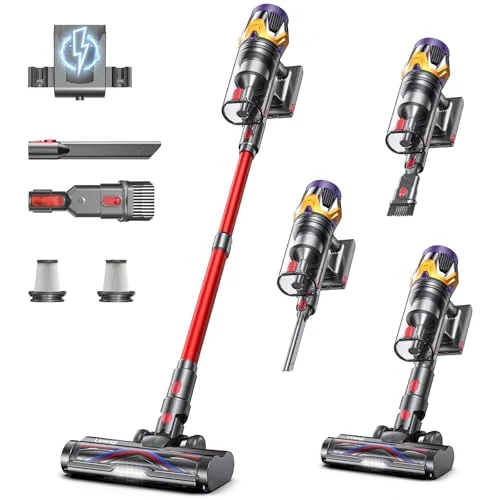
The specification page is only the beginning
Marketplace listings are designed to make unlike products look comparable. One machine advertises 55 kPa, another says 45 kPa, and both display an impressive maximum runtime. Those numbers appear tidy enough to rank, but their test conditions are not supplied. Suction pressure alone does not reveal airflow through the assembled floorhead, brush agitation, large-debris pickup or embedded-carpet extraction.
The Uosogi listing claims up to 55 kPa in its regular modes, up to 60 kPa in Hurricane Mode, as much as 70 minutes of runtime and 99.99 percent filtration. It does not provide an independent cleaning test, a runtime table by mode and attachment, or a complete-machine emissions result.
The Curvymoontech listing claims up to 45 kPa, as much as 40 minutes in Eco and 20 minutes in Turbo, plus five-layer filtration. Its exact-model owner record includes a much shorter maximum-power result, so the advertised ceiling should not be mistaken for the way most demanding cleaning sessions will behave.
This does not mean every claim is false. It means a claim without a disclosed method has limited buying value. A modest owner account that identifies the floor type, power mode, area cleaned and remaining battery can tell you more than a large number printed beside a lightning-bolt graphic.
Seven checks that reveal the real ownership proposition
-
Find the exact battery before buying the vacuum
A removable battery is useful only when the correct replacement can actually be obtained. Ask for the battery’s printed model number, voltage, connector type and a working purchase page. A reply that says a replacement is “available through support” is not equivalent to a stocked, identifiable part.
Save the answer and the product page. Marketplace brands can revise a listing while retaining a familiar-looking shell, and visually similar packs may use different wiring or charging electronics. Do not assume a battery from a sibling model is safe because it slides into the same shape.
-
Trace the charger with the same care
Proprietary chargers are easy to overlook because they rarely improve cleaning performance. They become decisive when the original is lost or fails. The Uosogi listing explicitly directs owners to use only its original X9 Turbo adapter, yet the supplied record does not establish a clear replacement route.
Ask for the charger part number, output specification and purchase link. Do not substitute a vaguely compatible adapter based only on plug fit, since voltage, polarity and charging control also matter.
-
Look for every consumable, not merely a spare in the box
A second filter extends the interval before the first purchase, but it does not create a parts supply. Verify the exact filter set, pre-filter, brush roll and any small seals that must be replaced. Check whether the manual identifies which elements are washable and how long they must dry before reuse.
Dust cups, latches and gaskets deserve equal attention. The DB5 owner who lost use of the vacuum after its cup tabs broke illustrates why a cheap plastic component can determine the lifespan of the whole appliance. A parts catalogue that offers batteries but not bins or seals is incomplete.
-
Identify who actually honors the warranty
Record the legal company name, contact address, claim procedure, coverage period and exclusions. A marketplace promise of round-the-clock service is not meaningful if the seller redirects the buyer to the retailer and the retailer redirects the buyer back.
Ask one specific question before ordering, such as how to buy a replacement dust cup. The usefulness, precision and speed of the response provide a small but relevant preview of the support route. Silence, scripted reassurance or an answer without a part number should lower confidence.
-
Translate maximum runtime into your cleaning routine
Runtime normally changes with power mode, powered attachments, floor resistance, battery condition and age. A maximum figure may describe the least demanding setting rather than the mode used for carpet, door mats or heavy debris. Look for separate results for low, medium and maximum power with the motorized head attached.
Measure your own likely session in rooms or minutes. A small apartment that needs ten minutes of routine hard-floor cleaning poses a different problem from a multi-level home with stairs and carpet. Cord Edge’s guide to cordless runtime claims explains how to turn a headline maximum into a practical expectation.
-
Match the evidence to the hardest floor in the home
Loose crumbs and pet hair on hard flooring are relatively forgiving tasks. Deep carpet, plush rugs and embedded fur demand useful brush agitation, sustained airflow and a head that does not bog down or clamp itself to the surface. Success on kitchen debris does not establish success in a carpeted bedroom.
The Uosogi owner evidence supports ordinary carpet maintenance but not controlled deep extraction. The DB5 appears useful on low-pile surfaces, while one thick plush rug defeated it. Buyers with substantial carpet should use the cordless carpet recommendations rather than treating a kPa claim as proof.
-
Separate a filter claim from a sealed vacuum
A listing may describe many filtration layers or attach a high percentage to the filter material. That does not show that all exhaust passes through the filter, that the bin and joints remain sealed, or that emissions were measured from the complete machine. Bagless emptying can also expose the user to collected dust even when the filter itself is efficient.
Neither product in this guide has supplied independent evidence of allergy-grade complete-machine containment. Anyone buying for asthma or serious dust sensitivity should read the guide to HEPA filtration and sealed systems before relying on a layer count.
How the two featured vacuums survive the audit
| Buying check | Uosogi X9 Turbo | Curvymoontech DB5 |
|---|---|---|
| Best-supported use | Routine debris and pet hair on hard floors, with ordinary carpet maintenance. | Short hard-floor passes, loose pet hair, furniture, stairs and car interiors. |
| Strongest practical feature | Stable self-standing design with toggle power and a momentary boost control. | Light, low-reaching handling with a useful illuminated swiveling head. |
| Runtime evidence | Owners report useful low-mode endurance, but no controlled 70-minute powered-head result is supplied. | One owner reports about ten minutes on maximum, while another cannot complete a whole home per charge. |
| Carpet confidence | Reasonable for surface maintenance, without proof of deep extraction. | Limited to surface pickup on low pile, with a reported failure on a thick plush rug. |
| Battery and charger trail | The battery is removable, but exact replacement availability and an original-charger purchase route remain unclear. | The battery is removable, but stable replacement availability for the current listing is not established. |
| Parts and support | No documented catalogue establishes continuing supply of the battery, charger and filters. | A broken dust cup produced an unsuccessful support loop and no clear replacement route. |
| Filtration confidence | The advertised multilayer system is not independently verified as sealed or allergy-grade. | The advertised five-layer system is not independently verified as sealed or allergy-grade. |
| Cord Edge judgment | A calculated option for buyers who value its ergonomics and verify parts before purchase. | A secondary quick cleaner for buyers who can tolerate short life and support uncertainty. |
The complete product-specific evidence is set out in Cord Edge’s Uosogi X9 Turbo review and Curvymoontech DB5 review. Read those before choosing either machine, since their strengths do not cancel their ownership risks.
What to do during the return window
An unfamiliar vacuum should be audited as soon as it arrives, not after the packaging has vanished. Photograph the model labels on the vacuum, battery and charger. Save the manual, seller identity, warranty language and product listing as they appeared on the purchase date.
Charge the battery according to the supplied instructions, then run the machine through the cleaning jobs that matter in your home. Try the powered head on the most demanding carpet or rug, test steering under low furniture, use the handheld attachments and note whether the bin empties without digging through hair. Check whether maximum suction grabs lightweight mats or makes the head difficult to push.
Inspect the roller, seals, dust-cup tabs and charging connection after several sessions. Remove and reinstall the battery, filter and bin so that a poor latch or confusing maintenance design appears while a return remains possible. If the vacuum stands on its own, give it only a cautious test and use the wall mount for regular storage when the chassis tips easily.
Contact support once with the model and serial details, then request the battery, charger, filter and dust-cup part numbers. If the seller cannot answer while the listing is active and the sale is recent, there is little reason to expect a better answer years later.
Keep it when the evidence closes the loop
- The hardest floor in your home is cleaned adequately without living on maximum power.
- One normal session fits comfortably within the observed battery endurance.
- The bin, roller and filters can be serviced without stressing fragile latches.
- Exact replacement parts have model numbers and credible purchase routes.
- The warranty provider responds with a usable claim process.
Return it when ownership already feels improvised
- The seller answers compatibility questions with reassurance instead of part numbers.
- Maximum power is required for ordinary cleaning and drains the battery too quickly.
- The head stalls, seals shift, plastic joints flex or the machine tips dangerously.
- Filtration claims remain vague despite allergies being a central reason for buying.
- The vacuum cannot handle the carpet, rug or pet-hair load it was purchased to clean.
When the cheaper-looking choice is not the economical one
Purchase cost is only the entry fee for a cordless vacuum. Batteries age, filters are consumed, brush rolls wear and chargers get lost. A machine with a lower initial cost can become the expensive choice if one unavailable component forces replacement of the entire appliance.
That does not require buying a premium flagship. It requires comparing the complete ownership chain. The lower-cost cordless guide provides alternatives when cordless convenience is essential, while a model such as the corded Shark Rocket can avoid battery aging entirely. Cord Edge’s Shark HV301 review explains the compromises of taking that route.
A corded stick is not automatically better: the cable limits reach and quick-clean convenience, and some lightweight models remain surface cleaners rather than deep-cleaning uprights. It is nevertheless worth considering when unlimited runtime and a simpler ownership proposition matter more than cordless freedom. The corded-versus-cordless guide helps decide which inconvenience you would rather live with.
Cord Edge’s final answer remains no for most buyers considering either featured machine as their household’s only vacuum. The Uosogi X9 Turbo earns a narrow exception for mostly hard-floor homes whose owners can verify its parts trail, while the Curvymoontech DB5 belongs in a secondary quick-clean role where failure would not leave the household stranded.
Frequently Asked Questions
Are unfamiliar cordless-vacuum brands always a bad buy?
No, but an unfamiliar brand is a sensible gamble only when cleaning evidence fits your home and the battery, charger, filters, parts and warranty can all be traced.
Can a large kPa number identify the strongest cleaner?
No, because pressure without a disclosed method does not establish airflow, brush performance, floorhead efficiency or carpet extraction.
Is a removable battery enough to make a vacuum repairable?
No, because the exact compatible pack must also have an identifiable model number and a dependable purchase route.
Should advertised maximum runtime be used for planning a full clean?
No, because the maximum commonly reflects a lower-power condition and may be much longer than endurance with the powered head at strong suction.
Can the Uosogi X9 Turbo serve as the main vacuum?
It may suit a small or medium home dominated by hard floors and ordinary rugs, but it remains a risky only vacuum when parts continuity, allergy containment or deep carpet cleaning matters.
Can the Curvymoontech DB5 serve as the main vacuum?
It is better treated as a secondary cleaner because maximum-power endurance, thick-rug performance, dust-cup durability and replacement support are all concerning.
Does multilayer filtration mean a vacuum is suitable for allergies?
No, because the entire airflow path must control leakage and complete-machine filtration needs verification rather than inference from the number of layers.
What is the most revealing question to ask the seller?
Ask for working purchase links and exact part numbers for the battery, charger, filters and dust cup, since a vague answer exposes the ownership risk quickly.