The runtime on the box is not the runtime on your floor
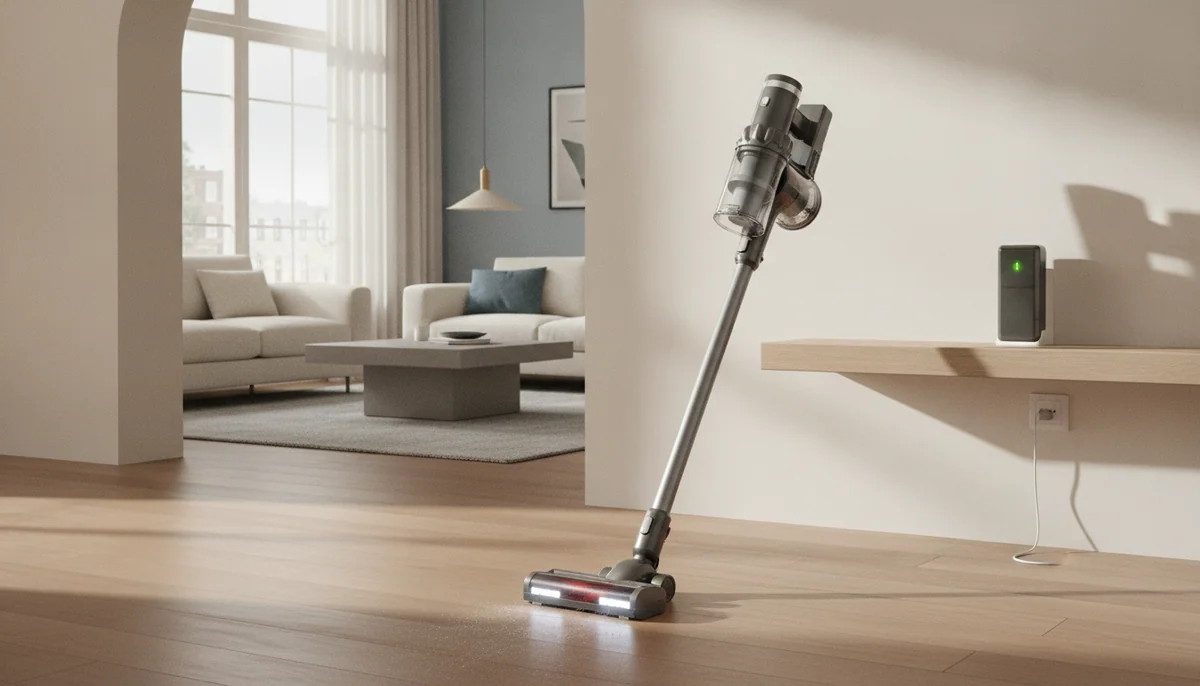
“Up to 60 minutes” sounds like a schedule. It is usually a boundary. The number may describe low-power use with no motorized floorhead, little resistance and a fresh, fully charged battery. Put that same vacuum on carpet, attach a spinning brush and select its strongest mode, and the hour can collapse into eight, ten or fifteen minutes.
This does not make every runtime claim false. It makes the test condition inseparable from the number. Dyson explicitly says that V11 runtime varies with the power mode, dust level, floor type and attachment, while BLACK+DECKER’s 44-minute figure for the BHFEA520J was measured as a hand vacuum on low power with no attachment. Both statements can be technically accurate while describing something quite different from vacuuming a carpeted living room.
The practical verdict is blunt: do not buy a cordless vacuum because its largest battery number matches the time you spend cleaning. Buy it only if its lower, more realistic powered-head runtime fits your route, or if the battery can be swapped before that route is finished.
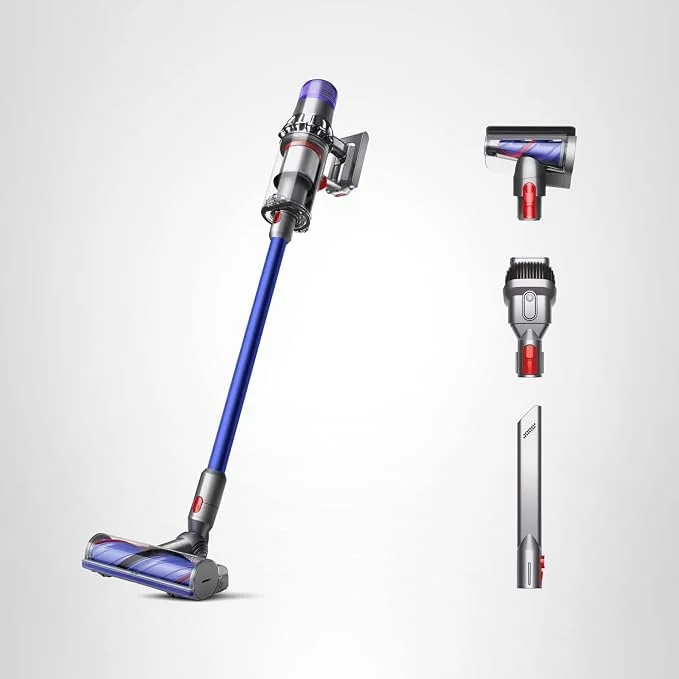
One battery powers several different machines
A cordless stick vacuum changes character when you change its mode or attachment. In low or Eco mode with a passive crevice tool, the battery powers little more than the suction motor and electronics. Fit a motorized floorhead and it must also turn a brush against the floor. Select Auto and the vacuum may increase power when it detects carpet or heavier debris. Select Boost or Max and the suction motor draws far more energy.
That is why a single runtime figure cannot describe every job. The relevant question is not merely how long the battery contains charge, but how quickly the vacuum consumes it while doing useful work.
What shortens a cleaning session
- Higher suction: Boost, Turbo and Max exchange endurance for stronger airflow.
- A powered tool: the floorhead, upholstery brush or stair tool adds another motor to the electrical load.
- Carpet resistance: a rotating brush and sealed head work harder against dense or plush fibers than over an open hard floor.
- Automatic adjustment: a vacuum that senses debris or carpet can repeatedly raise its power without the user touching a control.
- Restricted airflow: a full bin, dirty filter, wrapped roller or partial blockage can make cleaning less effective and encourage unnecessary use of a stronger mode.
- Battery condition: low temperature, heat exposure, repeated cycles and ordinary aging can reduce the capacity available to the machine.
Lights, screens and sensors also use energy, but they are seldom the main reason a claim and a carpet session differ so sharply. Suction setting and powered attachments dominate the calculation. Turning off a headlight will not convert a ten-minute maximum-power run into an hour.
What 40 and 60 minutes mean on real models
| Vacuum | Headline claim | Condition or evidence | Sensible expectation |
|---|---|---|---|
| BLACK+DECKER BHFEA520J | Up to 44 minutes | Hand-vacuum mode, low power, no attachment and a 2.0Ah battery | Short routine sessions rather than 44 minutes of powered carpet cleaning |
| Dyson V8 | Up to 40 minutes | Controlled results reach the low 40s in favorable use, while Max with a powered head falls to roughly single-digit minutes | Regular mode for the route and Max for isolated dirty patches |
| Dyson V11 Origin | Up to 60 minutes | Independent V11 results range from about 65 minutes in Eco to roughly 33 in an everyday mode and 8 to 15 in Boost | A useful medium-power session, not an hour of maximum suction |
| Dyson V15 Detect Plus | Up to 60 minutes | Low-power use can approach the maximum, while Auto with a powered head is much shorter and Boost clusters around 8 to 10 minutes | Let Auto handle the route and treat Boost as a spot tool |
The V8 illustrates the gap cleanly. Its listing qualifies the 40-minute figure by mode, dust level, floor and attachment. Independent testing supports a favorable run around that headline, but maximum-power testing with the powered head lands around eight or nine minutes. Its several-hour recharge then turns an exhausted battery into the end of the session rather than a brief pause.
The V11 provides more breathing room without abolishing the tradeoff. Independent tests of V11 variants recorded approximately an hour in Eco, around half an hour in an everyday setting and a steep fall in Boost. The exact times differ because the variants and methods differ, yet the operating pattern is consistent enough to guide a purchase: Eco supplies endurance, the middle mode does most of the cleaning, and Boost attacks a stubborn area.
The V15 makes this compromise easier to manage rather than making it disappear. Its Auto mode responds to debris and floor conditions, and its display revises the remaining-time estimate as the mode and tool change. That is genuinely useful because a live estimate can help a cleaner reduce power before the machine stops. Controlled evidence still places powered-head Boost use at only a small fraction of the advertised hour.
Square footage is a seductive but weak promise
A claim that one charge covers a certain floor area sounds more concrete than minutes, but it hides nearly as much. One thousand square feet of open hard flooring is not the same job as one thousand square feet divided among rugs, furniture, stairs and carpet. A quick maintenance pass is not the same job as slow overlapping passes over embedded debris.
Household reports therefore conflict without necessarily disproving one another. One owner may finish a large home on medium power because most rooms have smooth floors and little visible debris. Another may exhaust the same model in a smaller house because it increases power on carpet, drives a motorized tool and makes repeated passes through pet hair.
Measure your own cleaning route in minutes instead. Time an ordinary session with your current vacuum, excluding time spent moving furniture, emptying the bin or changing outlets. Then separate the route into the work that genuinely needs strong suction and the work that can be handled at a lower setting. That result is far more useful than asking whether a stranger finished an unspecified house.
Max mode is a tool, not a personality
Maximum power creates impressive demonstrations because the difference is audible and immediate. It is also the setting most likely to make a cordless vacuum feel defective when the battery indicator falls rapidly. The short duration is often a direct consequence of spending stored energy faster, not proof that the battery has failed.
Use the strongest setting deliberately: a dirty entrance mat, a concentrated patch of litter, grit buried in a rug or a few passes over a stubborn carpet area. Return to the normal setting once that patch is clear. Running Max continuously wastes endurance on easy debris and can leave the last room untouched.
This is also why suction specifications and runtime should never be judged separately. A vacuum can advertise formidable peak suction and a long maximum runtime because each figure describes a different operating mode. It does not deliver both at once. Cord Edge’s guide to stick-vacuum suction measurements explains why air watts, watts, volts and kPa cannot settle the cleaning question by themselves.
The battery gauge can be honest and still be wrong later
A percentage icon is an estimate, not a direct view inside the cells. Simple bar displays divide an uncertain remaining charge into a few coarse steps. More advanced vacuums calculate remaining minutes from recent power consumption, the selected mode and sometimes the attached tool. Their predictions can rise or fall when conditions change.
A live countdown is most useful after the vacuum has been running long enough to observe the job. If a V11 or V15 changes from Eco with a crevice tool to Auto with a motorized head, the estimate should fall because the electrical load has changed. That revision is not dishonesty. It is the display replacing an irrelevant prediction with a better one.
No gauge can promise what the next room contains. Thick carpet, a clog or an automatic increase over a dirty patch can consume charge faster than the previous room. Plan with a margin instead of trying to arrive at the dock with exactly zero seconds remaining.
Recharge time decides whether short runtime is tolerable
A 25-minute working session might be perfectly adequate if the vacuum returns to a dock after every quick cleanup. It is much less adequate when a 40-minute job must be split by a four-hour recharge. Battery capacity tells only half of that story; recovery time determines the cost of getting the estimate wrong.
The V8 commonly needs roughly four to five hours to recharge, and independent V11 tests place a full charge at roughly four to four and a half hours. These are not “finish after lunch” machines when a nearly complete route remains. A second battery can solve that interruption only when the pack is genuinely removable, compatible batteries are obtainable, and charging arrangements allow both packs to stay ready.
A battery secured by screws is replaceable for repair, but it is not swappable in the practical sense. You will not normally stop in a hallway, fetch a screwdriver and rebuild the vacuum around another pack. Buyers who expect to rotate batteries should verify the exact model and package rather than assuming that every version within a product family uses the same release system. Our guide to removable cordless-vacuum batteries covers the serviceability and spare-pack tradeoffs in more detail.
Two machines that use their battery honestly
The Dyson V11 Origin is the stronger all-round recommendation when a cordless vacuum must clean meaningful carpet and pet hair without jumping to the most elaborate flagship. Its useful everyday runtime is far below the headline hour, and its full recharge is slow. It is also top-heavy, requires the trigger to be held and may be difficult to push on very plush carpet. Those drawbacks belong in the decision before any buying exit.
The Dyson V8 makes the opposite case. Its modest battery and single-digit Max endurance rule it out as the unquestioned cleaner for a large carpeted house. Its lighter, more compact body remains valuable for a small home, stairs, upholstery, the car and frequent messes that would not justify fetching a heavier machine. The mature platform also makes replacement batteries and parts easier to investigate, although its screw-fastened pack cannot be swapped conveniently during a cleaning session.
Neither is a universal answer. Buyers who need maximum-power cleaning across room after room should consider whether cordless convenience is solving the right problem. A good corded stick vacuum trades outlet changes for uninterrupted operation, and Cord Edge’s corded and cordless comparison explains when that bargain is worth making. The corded stick-vacuum guide is the more useful next stop when charging breaks would be unacceptable.
Battery aging changes the answer
The runtime of a new battery is not a lifetime guarantee. Rechargeable cells gradually lose usable capacity through age and charge cycles, while sustained heat and demanding use can accelerate the loss. A route that once ended with charge remaining may eventually end one room early.
Do not diagnose every shortened session as a worn battery. A dirty filter, packed bin, obstructed airway or brush roll bound with hair can reduce pickup and make the user spend longer or select more power. Cold storage can also affect immediate behavior. Clean the airflow path, fully charge the pack and repeat the same familiar route before deciding the cells are finished.
A sudden collapse deserves different attention from gradual decline. If a machine that normally runs for half an hour shuts down after a minute, pulses repeatedly or stops when a powered tool is attached, check the filter, blockages, brush and electrical contacts before ordering a battery. A replacement pack cannot repair a seized floorhead, damaged charger, bad trigger or failing control board.
Off-brand machines make this more consequential. A detachable pack sounds reassuring, but it creates little long-term value if the seller does not maintain a supply of compatible replacements. The Curvymoontech DB5 listing, for example, separates a 40-minute Eco ceiling from a 20-minute Turbo claim, while retained owner evidence includes about ten minutes at maximum power and older model-family reports of substantial decline. The present unit may not repeat every older fault, but the evidence is enough to make replacement support part of the purchase rather than an afterthought.
How to estimate the runtime you will actually get
Find the footnote
Look for the tested mode, attachment, floorhead, battery capacity and any language such as “at the hand vacuum.” If those conditions are missing, treat the number as an unsupported ceiling rather than a schedule.
Identify your dominant floor
Mostly open hard floors usually place a lighter burden on the machine than dense carpet, rugs and motorized stair cleaning.
Choose the normal mode first
If credible evidence says the machine cleans ordinary debris in its regular setting, calculate around that mode and reserve maximum power for exceptions.
Add a working margin
Do not choose a vacuum whose realistic estimate merely equals your timed route because battery aging, dirtier rooms and tool changes will consume that margin.
Check the recovery plan
Confirm recharge time, battery removal method, spare-pack compatibility, warranty terms and replacement availability before depending on a second shift.
The right cordless runtime is not the longest one printed in a comparison table. It is the shortest credible figure that still lets you complete the cleaning you actually do. A small apartment may be well served by 20 practical minutes. A carpeted family home may find 40 insufficient. The job decides whether the battery is generous, not the marketing adjective beside it.
Frequently Asked Questions
Does a 60-minute cordless vacuum run for an hour on carpet?
Usually not, because the hour commonly describes favorable low-power use while carpet, a powered head and stronger suction consume charge much faster.
How long does a cordless stick vacuum run at maximum power?
Many examples last roughly eight to fifteen minutes at maximum power, although the exact result depends on the model, tool, floor and battery condition.
Is Eco mode strong enough for normal cleaning?
Eco can handle light debris on easy floors, but regular or Auto mode is usually the safer baseline when rugs, carpet or heavier dirt are part of the route.
Why does the remaining-time display suddenly drop?
The estimate falls when higher suction, a powered attachment, carpet resistance or automatic dirt detection raises the machine’s energy use.
Should I leave a cordless vacuum on its charger?
Use the storage and charging instructions for the exact model because its battery-management system and manufacturer guidance determine the intended routine.
Will a spare battery double the cleaning time?
A charged equivalent pack can roughly extend the session, but only if the battery is designed for quick swapping and both packs can be kept properly charged.
How do I know when the battery needs replacing?
Suspect gradual capacity loss only after a full charge and basic airflow maintenance fail to restore a familiar route that the vacuum previously completed.
Is a corded vacuum better for a large house?
A corded vacuum is usually the safer choice when the job requires long uninterrupted high-power cleaning and outlet changes are less disruptive than hours of recharging.