Stick vacuums can clean carpet, but only the right floorhead can clean it deeply
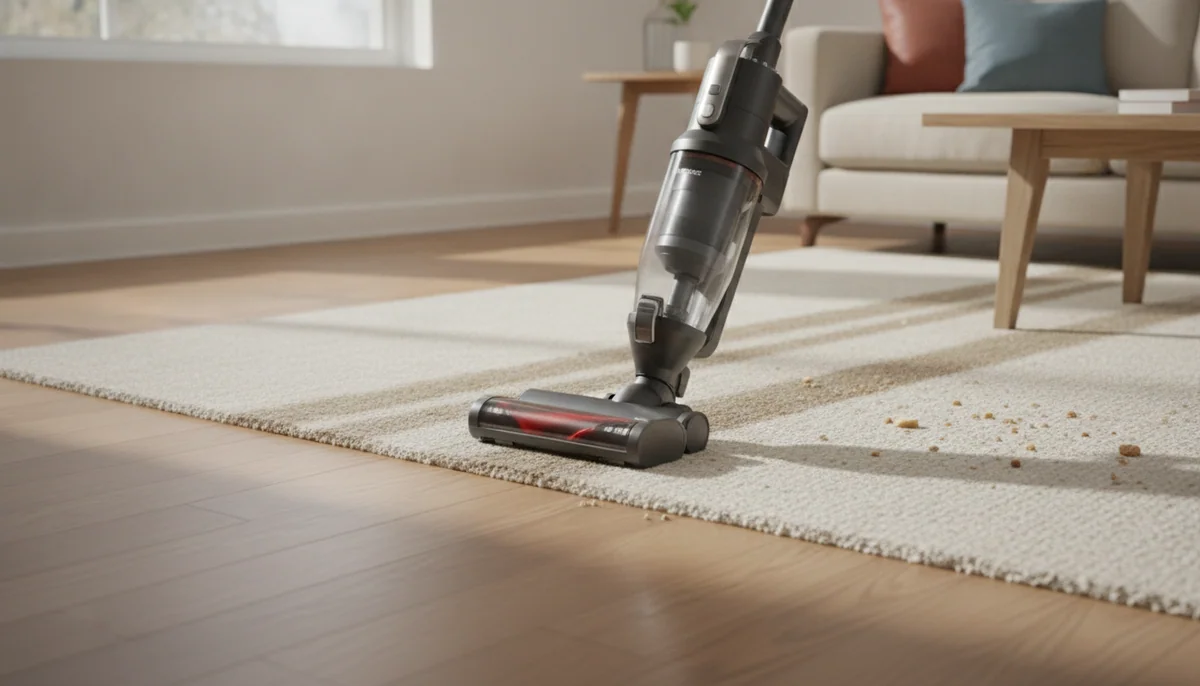
The shape of a vacuum does not decide whether it works on carpet. The floorhead does. A slim stick with a powered brush roll, a sensible seal and enough airflow can pull hair and grit from carpet surprisingly well; a machine with impressive-looking suction claims but no agitation may leave the pile groomed on top and dirty underneath.
That distinction explains why buyer experiences seem contradictory. One person replaces a bulky upright with a cordless stick and wonders why they waited. Another passes an electric broom over the same rug three times, sees crumbs disappear and later discovers that hair and fine grit remain buried in the fibers. Both machines may be sold for “carpet,” but they are not equipped for the same job.
Cord Edge’s answer is therefore a qualified yes. Strong models such as the Dyson V11 Origin make a credible case as primary carpet cleaners in many homes, while lighter machines such as the Dyson V8 are better suited to frequent maintenance and smaller spaces. Suction-only designs such as the Bissell Featherweight 2033M and Eureka Blaze NES215A are useful electric brooms, not miniature deep-cleaning vacuums.
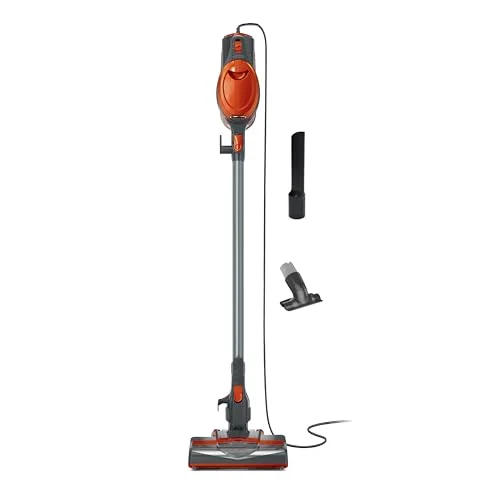
The brush roll is the dividing line
Carpet holds debris in three dimensions. Crumbs and lint may sit on the surface, but dust, sand and hair work downward between fibers as people walk over them. Suction must then compete with the pile, the backing and the friction holding that material in place.
A powered brush roll changes the contest. Its bristles or fins flex the carpet, disturb embedded debris and sweep material toward the intake. Suction then carries the loosened material through the head and into the bin. Straight suction can remove what is already exposed, but it cannot perform the same mechanical work below the surface.
The basic Bissell Featherweight illustrates the limit particularly well. Its tightly focused intake can collect small debris and even perform impressively over crevices, yet controlled testing found little carpet agitation and extremely poor pet-hair removal from low-pile carpet. The Eureka Blaze uses a wider, more accommodating opening and steers better around furniture, but it also omits a powered roller. In a direct comparison of inexpensive electric brooms, the Eureka handled larger loose debris more readily while neither design became a convincing deep-carpet cleaner.
This is why a clean-looking pass can mislead. Removing visible crumbs proves surface pickup. It does not prove that fine grit, dander and hair have been extracted from the base of the pile. If your shortlist contains a brushless floorhead, read “carpet” as occasional low-pile surface cleaning unless stronger evidence says otherwise.
Choose a powered floorhead for any home where carpet matters, and treat a suction-only nozzle as an electric broom even when the listing calls it a carpet vacuum.
Four things decide whether a stick vacuum is actually good on carpet
Agitation
The roller must disturb the pile without merely polishing its surface. Bristles tend to grip carpet well, while fins and mixed-material rollers can improve hair handling, but the implementation matters more than the label.
Useful suction at the head
Motor watts, kilopascals and air watts describe different things and cannot be ranked as though they were one universal score. Head geometry, seals, airflow and resistance determine how much cleaning force reaches the carpet.
Mobility through the pile
A head that seals too aggressively can become exhausting to push, especially on plush carpet and loose rugs. Adjustable gates, power modes or height settings can make strong suction usable rather than merely impressive.
Enough endurance for the job
Cordless runtime falls when the powered head, resistant carpet and higher suction settings work together. A machine that cleans well for only a few minutes may still be excellent for a rug and poor for a carpeted house.
Pile height changes the answer
| Carpet type | Likely result | What to watch |
|---|---|---|
| Flat weave and commercial carpet | A powered stick vacuum can usually handle routine cleaning very well because debris has less depth in which to hide. | Strong suction may grab loose edges or lightweight mats. |
| Low pile | This is the easiest carpet for a capable cordless or corded stick to maintain as a primary cleaner. | Brushless electric brooms still leave embedded hair and grit behind. |
| Medium pile | Better models can clean convincingly when their powered heads combine agitation with useful airflow. | Battery consumption and push resistance rise as the head works harder. |
| Plush or high pile | Some powerful sticks can extract debris, but handling often becomes difficult and results vary sharply by floorhead. | A fixed-height head can bog down, seal to the pile or stall its roller. |
| Shag and long-fiber rugs | A conventional stick floorhead is often the wrong tool even when the motor has ample power. | Long fibers can wrap, jam the brush or be pulled into the intake. |
| Delicate and lightweight rugs | Careful cleaning may be possible with low power, a suitable attachment or brush control. | Rotating brushes, tassels and aggressive seals can damage or lift the rug. |
The harder the carpet is to push through, the less useful maximum suction becomes. The Dyson V11 platform has strong evidence for carpet and pet-hair pickup, including fine debris on medium pile and credible performance on deeper carpet, but that power can make a tightly sealed head demanding to move through plush flooring. Dropping to a lower mode can improve control, although a home dominated by shag or very deep pile remains a better candidate for an adjustable full-size machine.
The lighter answer is often enough for a smaller home
Not every carpet needs the strongest available cordless vacuum. A small apartment with low-pile flooring, one bedroom rug and carpeted stairs places more value on easy handling than on a large bin or maximum power. Frequent cleaning also prevents grit and hair from becoming as deeply established.
The current Dyson V8 package fits that role well. Its Motorbar provides real agitation, controlled testing found strong carpet pickup, and the included Hair Screw tool makes pet beds and upholstery more credible jobs than they are for a floor-only bundle. The shorter, lighter body is also easier to carry and aim than the V11.
The price of that agility is endurance. The V8’s advertised maximum belongs to favorable low-power use, while Max mode with the powered head lasts only minutes in controlled testing and a recharge takes hours. It can maintain carpet effectively, but a large home that requires high power across every room will expose the battery before it exposes the dirt.
Readers deciding between those two Dysons can use Cord Edge’s V8 and V11 comparison. The choice is not simply cheaper versus better: the V8 favors handling and quick deployment, while the V11 favors carpet power, bin capacity and longer practical sessions.
Corded does not automatically mean better on carpet
A power cord solves runtime and battery-aging problems, but it does not repair a mediocre floorhead. The Shark Rocket HV301 supplies nonstop operation and a powered roller, yet controlled testing found distinctly weak pickup on both low- and high-pile carpet. It remains more useful on hard floors, area rugs, stairs and upholstery than as the primary deep cleaner for wall-to-wall carpet.
That example is important because shoppers often use “corded” as shorthand for “powerful.” A cord tells you how energy reaches the motor, not how the head seals, how the roller agitates or how much debris is recovered. The same caution applies to cordless listings that lead with enormous motor-wattage or kPa claims. Cord Edge’s guide to vacuum suction specifications explains why those numbers cannot replace pickup evidence.
Pet hair needs agitation, capacity and maintenance access
Carpeted pet homes make three demands at once. The brush must lift hair from the fibers, airflow must move it into the bin, and the machine must remain usable after long strands begin wrapping around the roller. A strong first pass is not enough if the head becomes a tightly wound spindle after every room.
“Anti-tangle” generally means reduced wrapping, not immunity. Combs, vanes and conical tools can direct hair away from the roller, but long human hair and dense pet fur still gather at roller ends, bearings and narrow airways. A removable or easily accessible roller is therefore more valuable than absolute language on the box.
The Shark IX141 shows the difference between hair pickup and complete pet cleaning. Measured performance on carpeted pet hair was excellent, but the same platform offered weak fine-particle containment, ordinary hair wrapping and limited deep-carpet ability. It can make visible fur disappear while remaining the wrong choice for a household buying primarily to control dander or allergens.
A shedding household should also consider bin size and emptying. Hair occupies volume quickly, and a small cup can interrupt every room. Dense clumps may bridge around the separator instead of dropping cleanly, so even a one-touch door can require manual clearing. For a fuller shortlist, see the site’s stick vacuums for pet hair.
Runtime claims are least trustworthy on carpet
Carpet is a battery’s difficult surface. The powered brush is running, the head meets resistance and the user is more likely to select a stronger mode for embedded debris. Each factor shortens the session compared with a best-case test in low power, and some advertised maxima are measured with the hand unit rather than the powered floorhead.
The correct question is not “How long does it run?” It is “How long does it run with the carpet head in the mode I will actually use?” If that figure is missing, assume the headline is a ceiling rather than a schedule.
Plan a carpet clean without being fooled by the box
- Reserve maximum power for stubborn patches rather than entire rooms.
- Estimate coverage from powered-head runtime, not handheld or no-load runtime.
- Expect thick pile and a dirty roller to consume more energy than hard flooring.
- Check whether the battery is genuinely removable and whether a compatible replacement is obtainable.
- Keep a corded machine if several carpeted rooms routinely exceed one practical charge.
Our guide to real cordless stick-vacuum runtime goes deeper into modes, attachments, charging and battery aging.
When a stick vacuum can replace an upright
A capable stick can be the only vacuum in a small or medium home with low- or medium-pile carpet, provided its powered head has credible pickup evidence and its battery or cord can cover the cleaning route. Frequent use strengthens the case because debris is removed before it becomes heavily embedded.
Replacement becomes less convincing as carpet gets deeper, floor area grows or the household accumulates heavy shedding, tracked grit and fine dust. A full-size upright or canister can offer more sustained airflow, a larger dirt container, easier pushing through plush pile and continuous high-power operation. Those advantages are unglamorous, but they become obvious halfway through a large carpeted house.
| Home | Verdict | Reason |
|---|---|---|
| Small apartment with low-pile carpet | Usually yes | A proven powered-head model can cover the area without asking too much of its bin or battery. |
| Mixed floors with several rugs | Yes, with the right head | One powered multi-surface head can handle routine transitions when the rugs are not delicate or exceptionally deep. |
| Medium home with ordinary carpet and pets | Sometimes | Strong pickup, useful hair tools, adequate capacity and practical runtime all need to align. |
| Large wall-to-wall carpeted home | Usually not | Runtime, bin size, wrist loading and sustained deep-cleaning demands favor a full-size machine. |
| Plush, shag or delicate rugs | Not without careful matching | Fixed heads may seal down, wrap fibers or damage material even when pickup power is ample. |
| Severe allergies with extensive carpet | Choose containment first | Verified sealed filtration and low-dust disposal matter as much as what the brush removes from the pile. |
For a model shortlist, start with Cord Edge’s best stick vacuums for carpet or the narrower guide to cordless carpet models. Readers deciding whether to keep a full-size cleaner should use the separate guide to when a stick vacuum can replace an upright.
How Cord Edge reached this answer
Cord Edge did not conduct a new hands-on carpet test for this article. The conclusion synthesizes the site’s retained product reviews, controlled pickup and filtration findings, exact-listing qualifications, owner evidence and model-specific demonstrations. Instrumented carpet results received more weight than impressions of strong suction or a rapidly filling transparent bin.
Product families were kept separate where floorheads, filtration, batteries or accessory bundles differed. Manufacturer pressure, motor-power and runtime figures were treated as claims unless independently reproduced, and owner reports were used to describe recurring handling and maintenance patterns rather than to invent failure rates or laboratory scores.
The final answer remains yes, but not indiscriminately: buy a stick vacuum with a proven powered floorhead for low- or medium-pile carpet, and keep an upright or canister in the plan when deep pile, large floor area or severe dust sensitivity raises the standard.
Frequently Asked Questions
Can a cordless stick vacuum clean carpet deeply?
A strong cordless model with a well-designed powered head can deep-clean ordinary low- and medium-pile carpet, although thick pile and large floor areas may still favor a corded full-size machine.
Does a stick vacuum need a brush roll for carpet?
Yes for dependable embedded-dirt and hair removal, because straight suction mainly collects debris already exposed at the carpet surface.
Can an electric broom handle carpet?
A suction-only electric broom can remove loose material from flat rugs or low pile, but it should not be trusted with embedded grit, dust or pet hair.
Why is my stick vacuum difficult to push on carpet?
The head may be sealing too tightly or sitting too low in the pile, so reducing suction or using an intake or height adjustment can restore mobility when the model provides one.
Will a powerful vacuum damage a rug?
A rotating brush or aggressive seal can lift lightweight rugs, catch tassels or disturb delicate fibers, so use an appropriate low-power or suction-only tool when the rug maker permits vacuuming.
Is maximum power best for every carpet?
No, maximum power can shorten runtime, increase push resistance and grab loose rugs when a normal mode would provide adequate pickup.
Can a stick vacuum remove pet hair from carpet?
Models with effective powered rollers and pet tools can remove carpet hair very well, but anti-tangle designs still need periodic inspection and cleaning.
How often should carpet be vacuumed with a stick vacuum?
High-traffic and pet areas benefit from frequent maintenance passes, while periodic slower cleaning is still needed to address debris that routine quick passes miss.
Does a higher kPa number guarantee better carpet cleaning?
No, pressure is only one part of performance because airflow, roller agitation, floorhead seal and debris admission determine what reaches the bin.
Can a stick vacuum replace an upright in a carpeted apartment?
It often can when the apartment has low- or medium-pile carpet and the chosen stick has proven pickup, sufficient powered-head runtime and manageable bin capacity.
Should a carpeted allergy-sensitive home use a bagless stick vacuum?
Only if whole-machine containment is independently credible and the buyer accepts that opening a bagless cup can release dust during disposal.