Corded vs cordless stick vacuums: cordless wins for most homes
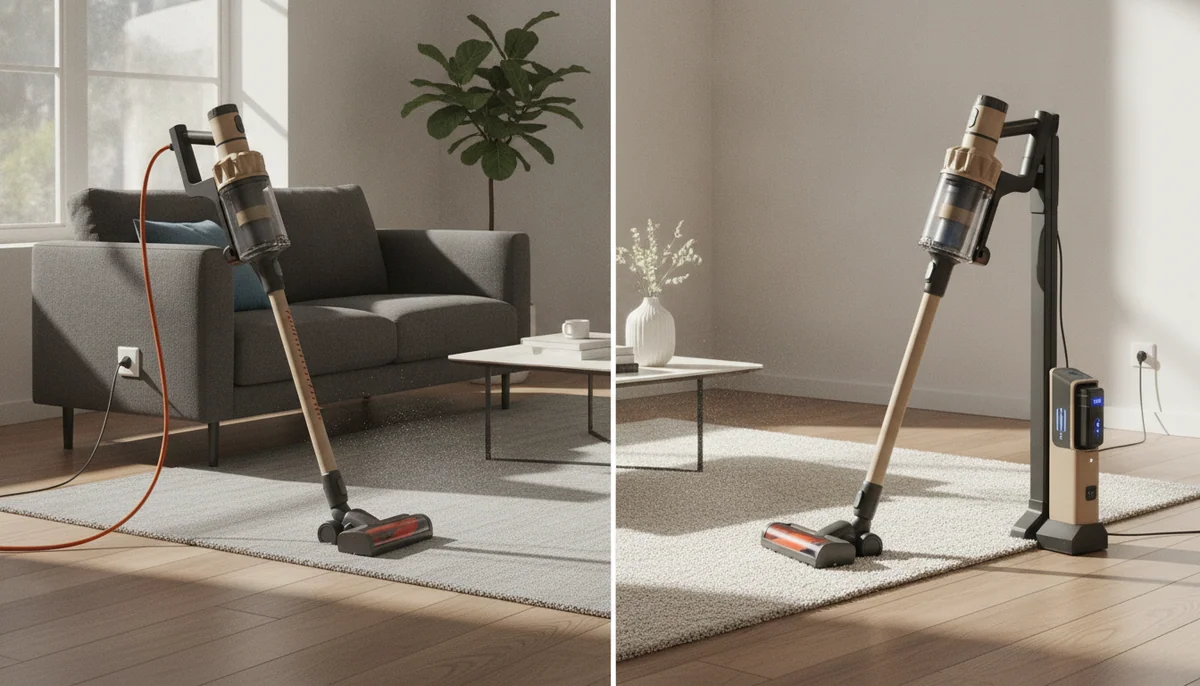
The battery is not the only difference between corded and cordless stick vacuums. It changes where the vacuum waits, how quickly it starts, how long it can clean, what eventually wears out and how much patience the owner must contribute. A cordless stick can turn a trail of crumbs into a 40-second job. A corded stick can turn the same mess into a hunt for an outlet, then keep working long after a battery-powered rival needs its charger.
That sounds like a balanced contest, but daily life is not balanced. Most stick-vacuum jobs are short, opportunistic and scattered across rooms. The machine that can be lifted from its dock and used immediately is more likely to catch cereal beneath a table, fur beside a sofa and grit near a doorway before those small messes become the weekend’s floor-cleaning project. Cordless wins that behavioral argument even before suction enters the discussion.
Corded still has a legitimate constituency. It makes sense for someone who cleans for long stretches, dislikes planning around charge, wants to avoid eventual battery degradation or cannot install a charger near the vacuum’s storage space. It can also deliver serious mixed-floor performance, as the Shark PowerDetect HZ4002 demonstrates, but a plug does not automatically make a vacuum more powerful or more capable. Floorhead design, agitation, airflow, filtration and sealing matter more than the presence of a cable.
Choose cordless if
- You clean in short bursts throughout the week.
- You move frequently between rooms, stairs or the car.
- A cord would make you postpone small cleanups.
- You have a practical place to charge the vacuum.
Choose corded if
- You regularly clean until the whole home is finished.
- You do not want runtime to vary with power mode.
- You would rather manage a cable than replace a battery.
- Your chosen corded model has the floorhead and filtration your floors require.
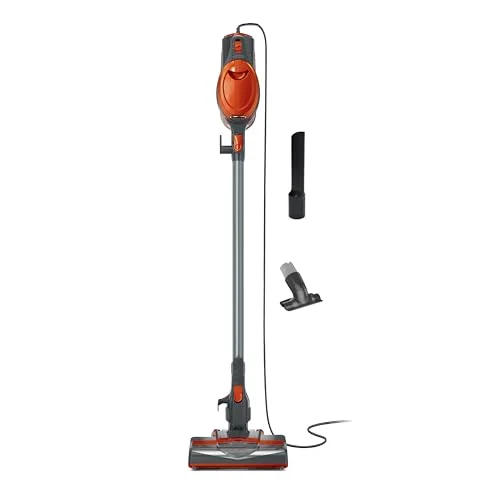
The cord is a constraint; the battery is a consumable
A corded stick vacuum asks for effort before, during and after cleaning. You unwind the cable, find a useful outlet, steer around the cable, change outlets when its reach ends and wrap it again when the job is done. A long cord reduces outlet changes, but it also creates more cable to guide and store. This friction is minor during a planned whole-home clean and disproportionately annoying during a two-minute pickup.
Cordless moves that inconvenience into the future. The vacuum must be charged, its maximum runtime depends on the mode and attachment, and the battery will lose capacity with age. A removable pack is preferable because it offers a route to replacement, but only when a compatible pack remains obtainable. Buyers should check the replacement battery, charger and filter situation for the exact model rather than assuming that a detachable part will be supported indefinitely.
Runtime headlines need translation. Dyson qualifies the V15 Detect Plus claim by noting that actual duration changes with power mode, debris, floor type and attachments. Shark’s longer IP3251 claim is measured at the handheld unit in Eco mode, not while driving its full floorhead through carpet. Those figures are useful for comparing controlled claims, but they are not promises that the vacuum will spend the entire stated period cleaning floors at maximum power.
If one normal cleaning session would consume most of a claimed maximum runtime, buy more battery capacity than the calculation appears to require, choose a model with a replaceable pack or accept that corded operation is the safer fit.
Do not confuse unlimited runtime with better cleaning
The outlet supplies continuous power, not automatic competence. The lightweight Amazon Basics 2-in-1 has a cord, yet its suction-only floorhead lacks a powered brush roll. That makes it a useful electric broom for loose debris and surface hair on hard floors, but a poor primary vacuum for carpet because it cannot agitate embedded material. Its 3.9-pound body and 19.7-foot cord are attractive for quick hard-floor work, while the 0.5-liter cup, wandering swivel head and uncertain replacement-filter path narrow its role.
The Shark Rocket HV301 illustrates a different kind of corded compromise. Its powered head, handheld conversion and roughly 25-foot reach make it much more versatile than a suction-only broom, and its narrow profile suits hard floors, rugs, stairs and upholstery. Independent testing nevertheless found weak carpet pickup and poor emissions performance, while the handle-mounted motor, small 0.40-liter cup, lack of HEPA filtration and inability to stand assembled make its age apparent.
A serious modern corded stick can compete on cleaning rather than merely endurance. The Shark HZ4002 combines a dual-roller head, automatic floor response, pickup in forward and reverse passes, self-standing storage and a sealed HEPA system. Its mixed-floor and pet-hair performance makes a strong case for keeping the plug, but its unusually stiff cord is not a footnote. Owners also face a small dust cup, awkward above-floor tools, a fixed rear roller and uncertainty around long-term component supply.
What cordless buys beyond freedom from outlets
Cordless makes the stick format coherent. A slim vacuum can move from kitchen to hallway, climb stairs and become a handheld without dragging its power source behind it. The advantage is greatest in split-level homes, furnished rooms, cars and any space where outlets sit in inconvenient places. It also helps when reduced mobility makes bending to plug and unplug a cable more difficult.
The best cordless machines no longer require accepting electric-broom performance. The Dyson V15 Detect Plus offers a dedicated illuminated hard-floor roller, a powered head with strong carpet pickup, automatic suction adjustment, useful pet-hair tools and a removable battery. Independent testing supports its cleaning and fine-particle containment strengths, so its appeal is not limited to the screen and particle graph.
Its drawbacks are equally tangible. The user must hold the trigger while cleaning, the motor and battery make handheld work top-heavy, the vacuum cannot stand unsupported, and the special illumination stays with the hard-floor head. Switching between hard floor and carpet can therefore mean switching heads. Emptying the bagless cup can also release dust despite excellent containment while the vacuum is running.
A dock can remove one chore while adding three others
A self-emptying cordless vacuum solves a specific interruption: handling the small onboard bin after every clean. Dock the machine and debris transfers into a larger base while the battery charges. That can be genuinely valuable for frequent cleaners, pet owners and anyone who tends to leave a full bin for next time. It does not remove filter washing, airway checks, roller maintenance or the eventual need to empty and clean the base.
The Shark PowerDetect IP3251 is persuasive because the vacuum beneath the dock is capable. Its twin-roller floorhead performs strongly across hard floors and ordinary low-pile carpet, its sealed system contains fine particles well, its flexible wand reaches beneath furniture and its removable battery provides a better long-term path than a permanently sealed pack. The dock reduces routine dust-cup contact and returns the vacuum to its charger.
The cost is bulk, weight and upkeep. The complete vacuum is heavy, Boost runtime is brief with the powered head, dense hair can obstruct the front roller or emptying path, and the primary brush roll is not readily removable. The dock occupies floor space, makes noise and adds its own filters. Buyers who do not mind emptying a cup are paying in space and maintenance for a convenience they may barely use.
The floor plan should make the final decision
| Home or habit | Better default | Reason | The catch |
|---|---|---|---|
| Apartment with mostly hard floors | Cordless | Fast retrieval and easy room-to-room movement suit frequent short cleanups. | A very light corded broom can be cheaper and never needs charging. |
| Large home cleaned in one session | Corded | Continuous operation removes runtime calculations and charging pauses. | The cable becomes more troublesome across doors, stairs and distant rooms. |
| Mixed hard floor and carpet | Either | The floorhead and carpet performance matter more than the power source. | Some cordless models require head swaps, while basic corded models may lack agitation. |
| Frequent pet-hair cleanup | Cordless | Immediate access encourages pickup before fur accumulates. | Small bins, rollers and auto-empty pathways still need inspection. |
| Allergy-sensitive household | Either | A verified sealed system and effective filtration outrank the cable question. | Bagless emptying can release dust even when operational filtration is excellent. |
| Buyer concerned about long ownership | Corded | No traction battery means no capacity loss or battery replacement decision. | Cords, hoses, powered heads and proprietary rollers can still fail. |
| Stairs, car interiors and quick handheld jobs | Cordless | Freedom from outlets and cables preserves the point of handheld conversion. | Handle-mounted batteries can make overhead work tiring. |
Carpet deserves special caution. Neither “corded” nor “cordless” confirms that a machine can lift embedded debris. Look for a powered brush roll, credible carpet results and a head that will not clamp itself to dense pile. Lightweight rugs can also expose aggressive suction or the absence of brush-roll control. Cord Edge’s guide to how stick vacuums behave on carpet separates surface pickup from genuine carpet cleaning.
Hard-floor buyers have more freedom because straight suction can handle loose crumbs and grit, but the nozzle still determines whether larger debris enters or gets snowplowed across the room. A soft roller can collect fine dust impressively, while a simple suction head avoids hair wrap and may be gentler on delicate surfaces. The trade is that the simpler head loses versatility once rugs and embedded hair enter the plan. Our brush-roll versus suction-only guide addresses that choice directly.
Five checks matter more than the word cordless
If cordless already fits the home, compare the models in Cord Edge’s best cordless stick vacuum guide. Buyers who prefer unlimited operation can move directly to the best corded stick vacuum guide. Those roundups address the product decision after the power-format decision is settled.
The final call
Cordless is the better default because it preserves the reason to buy a stick vacuum: quick, mobile cleaning with little setup. Corded is the deliberate exception for long sessions, battery-averse ownership and buyers willing to exchange cable management for continuous operation. Choose the exception only when that exchange solves a problem you actually have.
Frequently Asked Questions
Are corded stick vacuums more powerful than cordless models?
No, corded operation provides continuous power, but actual cleaning depends on airflow, agitation, floorhead design, sealing and how effectively debris reaches the bin.
Can a cordless stick vacuum clean an entire home?
Yes, if the home, chosen power mode and battery capacity fit within realistic powered-floorhead runtime rather than the maximum advertised figure.
Do corded stick vacuums last longer?
They avoid battery degradation, but their cords, hoses, switches, brush rolls, floorheads and proprietary parts can still limit useful life.
Is a removable cordless battery worth having?
Yes, provided compatible replacement packs are documented and obtainable for the exact model when the original battery eventually loses capacity.
Which type is better for carpet?
Choose the model with proven carpet pickup and an appropriate powered brush roll because the power source alone does not determine deep-cleaning ability.
Which type is better for pet hair?
Cordless usually makes frequent fur pickup easier, but brush-roll access, bin size, airway width and verified pet-hair performance matter more than the missing cord.
Which type is better for allergies?
Choose verified sealed filtration and a low-exposure emptying system regardless of power source because a HEPA label on one filter does not prove whole-machine containment.
Is a self-emptying cordless vacuum worth it?
It is worthwhile when automatic bin transfer will increase cleaning frequency or reduce dust handling, but it still adds floor space, filters, noise and maintenance.
Sources (3)
- Amazon listings and customer reviews
- Owner and reviewer video, 1 channel
- Rtings — Article — www.rtings.com