A stick vacuum can replace an upright, but only in the right home
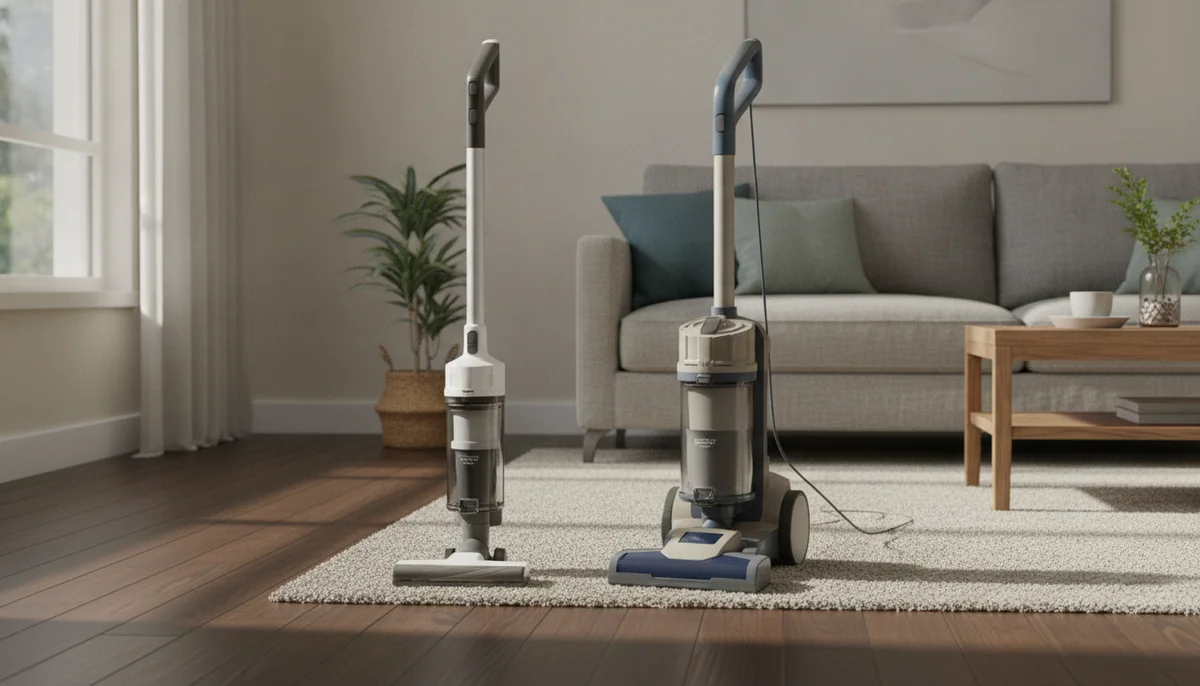
The dividing line is not whether a vacuum is shaped like a stick. It is whether that particular machine can perform every cleaning job your home actually creates. A premium cordless stick with a powered carpet head, useful everyday runtime and competent filtration belongs in a different category from a three-pound electric broom with straight suction and a fabric filter, even though retailers place both under the same label.
That distinction turns a vague category question into a practical test. A replacement must collect ordinary debris from every important floor, agitate carpet rather than merely skim it, finish the normal cleaning route without an unwanted charging stop, contain fine dust well enough for the household and remain comfortable through the entire job. Failure on one minor task may be tolerable; failure on the home’s dominant surface is not.
Convenience still matters. A lighter machine that comes out three times a week can keep a home cleaner than a powerful upright that emerges once a month. Cordless sticks are especially good at removing the ceremony from crumbs, stairs, upholstery and quick room-by-room cleaning. The mistake is assuming that frequent surface cleaning automatically equals periodic deep cleaning.
A stick can be your only vacuum when
Your home is compact, hard floors dominate, carpet is low or medium pile, the powered head cleans it convincingly and the normal cleaning route fits comfortably within the machine’s practical capacity.
Keep a full-size vacuum when
You have extensive plush carpet, deeply embedded pet hair, large quantities of debris, severe dust sensitivity or cleaning sessions that repeatedly exhaust a cordless machine.
The floor plan decides before the specifications do
Start with the surfaces underfoot, not the largest suction number printed on a product page. Hard floors mostly ask a vacuum to admit loose debris, maintain airflow and avoid scattering what it approaches. Carpet adds another job: the floorhead must agitate fibers so embedded grit and hair can enter the air path. A brushless electric broom may look impressive as crumbs disappear from tile, then leave a carpet apparently tidy while dirt remains below the surface.
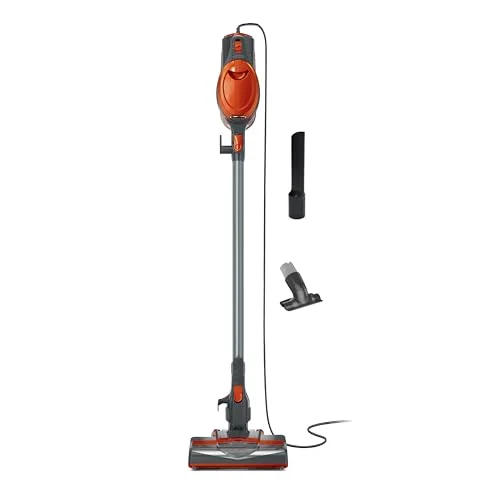
That is why the Bissell Featherweight 2033M, Eureka Blaze NES215A and Amazon Basics 2-in-1 should not be promoted into universal household vacuums. All three are unusually light corded cleaners suited to exposed debris on hard floors, and none has the powered brush roll needed for dependable carpet agitation. The Eureka generally offers the smartest budget shape because its swivel head and larger debris opening improve everyday handling, but its advantage over the Bissell does not change the class of work either machine can perform.
In a studio with sealed flooring and one flat rug, that narrow ability may be enough. The owner is not settling for an inadequate upright substitute if there is no meaningful deep-carpet job to perform. In a carpeted apartment, the same purchase becomes false economy because small square footage does not make embedded dirt easier to remove.
| Home and cleaning pattern | Replacement outlook | What the stick must provide |
|---|---|---|
| Small home with hard floors and a few flat rugs | Very plausible | Good loose-debris pickup, a practical bin, suitable filtration and comfortable handling. |
| Mixed floors with low or medium carpet | Plausible with the right model | A powered head, credible carpet results, enough runtime or cord reach and effective hair management. |
| Large home with extensive carpet | Usually a poor trade | Sustained agitation, high capacity and uninterrupted operation that many sticks do not deliver together. |
| Home with thick, shag or loose rugs | Model dependent | Usable suction control and a head that does not seal down, grab edges or become exhausting to push. |
| Heavy-shedding pet household | Possible, but demanding | Strong carpet and upholstery tools, a sensible bin and an airflow path that does not choke on fur. |
| Serious allergy or asthma concerns | Often better with a full-size bagged machine | Verified sealed filtration and disposal that does not release collected dust back into the room. |
The last row deserves particular weight. Good filtration while a vacuum runs does not make bagless emptying clean. Even a well-filtered premium stick opens its cup over a bin, where dust can escape during disposal. A bagged full-size vacuum can remain the better primary tool for a sensitive household even when a cordless stick is easier to maneuver. Broader independent guidance likewise treats plug-in machines as the safer answer for sustained carpet work and highlights the durability and battery compromises attached to cordless designs.
Carpet exposes the difference between pickup and cleaning
A clear dust cup is persuasive theater. Seeing hair, lint and gray powder after a pass proves that the vacuum collected something, but it does not reveal what remains in the floor. Brush agitation, head geometry, airflow and sealing pressure determine whether material buried in carpet reaches the bin. Strong suction at the motor cannot rescue a poorly matched floorhead.
The Shark Rocket HV301 illustrates the danger of judging by sensation. It feels forceful, has a powered brush and produces satisfying visible pickup, yet controlled testing found good bare-floor performance and distinctly weak results on both low-pile and high-pile carpet. That makes it a credible primary cleaner for a compact hard-floor home with scattered rugs, not a miniature deep-cleaning upright for wall-to-wall carpet. It also lacks HEPA filtration, cannot stand while assembled and places the motor’s weight at the hand.
With that verdict and its drawbacks established, the full Shark Rocket HV301 review is the useful next stop for a buyer who prefers uninterrupted corded operation and mainly needs hard-floor, stair and upholstery cleaning. Readers committed to mains power can compare more suitable powered designs in Cord Edge’s guide to the best corded stick vacuums.
A stronger powered-head cordless can cross the replacement threshold. The Dyson V11 Origin has convincing carpet and pet-hair performance, a larger bin than the V8 and enough normal-mode endurance to make whole-home cleaning plausible in many medium-sized homes. Its honest drawbacks are substantial: it is rear-heavy, requires continuous trigger pressure, cannot stand unsupported and can become difficult to push on deep carpet.
Those compromises do not disqualify it from replacing an upright; they determine who can tolerate the replacement. A healthy user in a mixed-floor home may gladly exchange the upright’s bulk and cord for the V11’s wrist load and charging routine. Someone with weak hands or plush carpet may discover that the ostensibly convenient machine is harder to operate where it matters most. The Dyson V11 Origin review works through that exact bargain.
The Dyson V15 Detect Plus makes an even stronger technical case. Its Digital Motorbar has produced excellent carpet and embedded-debris results, while its separate illuminated soft roller is unusually effective on hard floors. It also provides a removable battery, debris-responsive Auto mode and an excellent Hair Screw tool for upholstery. The cost of that versatility is two floorheads to swap, a held trigger, top-heavy handling, dusty bagless emptying and Boost runtime measured in minutes rather than anything close to an hour.
Once those limitations are acceptable, the Dyson V15 Detect Plus review describes one of the clearest candidates here for replacing a full-size dry vacuum in a hard-floor or mixed-floor home. It is not automatically the best choice for an all-carpet house because its signature illumination works only on the separate hard-floor head.
Runtime is capacity, not a promise printed in minutes
A cordless vacuum stops being an upright replacement the moment its ordinary cleaning route consistently outlasts the useful charge. Advertised maximums rarely describe powered carpet cleaning. They commonly reflect favorable low-power conditions, and maximum suction can reduce the available session to a small fraction of the headline number.
The Dyson V8 captures this trade particularly well. Its compact body, capable Motorbar and Hair Screw tool make it excellent for stairs, upholstery, pet hair and quick mixed-floor cleaning. Independent testing supports strong carpet pickup for its class, yet Max mode lasts only minutes and a recharge takes hours. Its battery is replaceable with tools rather than conveniently swappable during a session.
The drawback sets the boundary: the V8 can be the only vacuum in a small home whose routine fits regular mode, but it is a poor full-size replacement for several carpeted rooms that require sustained maximum power. Buyers whose homes fall on the favorable side can read the complete Dyson V8 review; everyone else should compare the stronger options in the cordless stick vacuum roundup.
Calculate the real cleaning session
- Time the route you actually clean, including stairs, rugs and furniture rather than open floor alone.
- Assume the powered head and ordinary mode will be used for most of that route.
- Add interruptions for cup emptying, hair removal and moving between tools or outlets.
- Reject a cordless model if finishing routinely depends on maximum power lasting as long as its Eco claim.
- Consider a removable spare only after confirming that the battery is genuinely user-swappable and separately obtainable.
Corded sticks avoid battery aging and charging stops, but they do not provide infinite practical range. A short lead can turn a larger home into a sequence of outlet changes, while the cord must be guided around furniture and wrapped afterward. The better choice depends on which interruption irritates you less, and Cord Edge’s guide to corded and cordless stick vacuums separates continuous power from freedom of movement.
Pet hair changes the workload twice
Shedding tests both pickup and maintenance. A capable powered roll must release hair from carpet and fabric, then the bin, filter and airway must accept the load without choking. A label such as “anti-tangle” addresses only one part of that route, and even a good detangling roller can collect long strands around its ends or bearings.
The V11 and V15 are persuasive pet-home replacements because their full-size heads pair with the Hair Screw upholstery tool. The V8 retains much of that usefulness in a smaller body but has less capacity and endurance. None removes the need to inspect rollers, empty before fur packs against the inlet and maintain washable filters.
At the budget end, the Eureka RapidClean Pro NEC280TL delivers surprisingly strong everyday pickup and useful headlights. Independent testing recovered high proportions of fine staged debris across hard floor and carpet, but repeated owner reports describe weak latches, loose springs and failed dirt-cup connections. Its integrated battery and qualified carpet ability further limit its claim as a long-term only vacuum.
With both its cleaning case and structural risk visible, the Eureka NEC280TL review is appropriate for buyers seeking a light daily cleaner who can accept durability uncertainty. It is easier to defend as an affordable companion than as the sole machine expected to survive heavy carpet and constant pet use.
The maintenance burden does not disappear; it moves closer
Full-size vacuums usually offer larger bags or bins, wider heads and more floor-supported weight. Sticks exchange those advantages for narrow maneuverability and easy storage. The resulting ownership rhythm includes more frequent emptying, more filter attention and, in cordless models, battery management.
A small cup is not inherently bad. It becomes bad when the household produces more debris than the owner is willing to empty, or when dense hair blocks airflow before the visible chamber appears full. Likewise, a washable filter can reduce consumable purchases while still creating a day of downtime if the vacuum cannot run until the rinsed filter is completely dry.
Repairability should enter the decision before the upright leaves the house. The BLACK+DECKER BHFEA520J is light, self-standing and convenient for everyday hard-floor debris, but its battery sits inside the body and exact-model parts records listed the roller and complete floorhead as unavailable. The Kenmore DS1020 provides a useful detachable handheld and hard-floor performance, yet its battery serviceability and broader parts support remain unclear while the filter path needs frequent clearing. Those are respectable secondary cleaners and weak candidates for a household’s single indispensable appliance.
A replacement vacuum should survive the failure of a consumable part without becoming waste. Before committing, check whether filters, batteries, floorheads and rollers exist for the exact model rather than a similarly named sibling. A removable battery is especially valuable when it turns expected aging into ordinary maintenance instead of an appliance replacement.
A five-part test before retiring the upright
Every important surface
The stick must clean the home’s dominant flooring well and handle secondary surfaces without requiring a rescue machine after every session.
The complete route
Its useful charge or cord reach must cover normal cleaning without turning every room into a battery or outlet calculation.
The household’s debris load
The bin, airway and roller must tolerate the actual quantity of hair, litter, crumbs and tracked grit produced between cleans.
The person using it
Hand weight, trigger pressure, push resistance and emptying effort must remain acceptable after the novelty of cordless cleaning disappears.
The dust after collection
Filtration and disposal must suit the household’s sensitivity rather than merely keeping visible debris inside the cup while the motor runs.
Do not decide from a demonstration on freshly scattered cereal alone. Use the stick as the only vacuum through several normal cleaning cycles if a return period permits it. Clean every carpeted room, the stairs, edges, furniture and the messiest pet area. Empty the cup as you ordinarily would, wash the filter when required and notice whether the machine is still comfortable near the end.
If it completes that routine without leaving an important job undone, the upright has become redundant. If the stick repeatedly needs maximum mode, a mid-clean recharge, another vacuum for carpet or a cloud of dust during emptying that the household cannot tolerate, keep the full-size machine. Convenience is a legitimate reason to switch, but only after the cleaner clears the work rather than merely lowering the effort required to begin it.
Frequently Asked Questions
Can a cordless stick vacuum clean carpet as well as an upright?
A strong powered-head cordless can match an upright on many routine carpet jobs, but extensive deep pile, long high-power sessions and heavy embedded debris still favor a capable full-size machine.
Can an inexpensive electric broom be the only vacuum in an apartment?
It can be sufficient in a small mostly hard-floor apartment, but even a tiny carpeted home needs powered agitation if embedded dirt and hair matter.
Is a corded stick automatically more powerful than a cordless one?
No, a cord guarantees continuous electrical supply but does not establish useful suction, floorhead quality, carpet pickup or filtration.
How much cordless runtime is enough for an only vacuum?
Enough runtime means completing the normal route with the powered head in ordinary modes while retaining a reasonable margin for dirtier areas and battery aging.
Do stick vacuums work in homes with pets?
Yes, provided the machine has effective floor and upholstery tools, enough bin capacity and an airway that can handle the household’s actual shedding load.
Does an anti-tangle brush mean the roller never needs cleaning?
No, detangling systems can reduce hair across the brush but long strands may still gather around roller ends, bearings and other parts of the airflow path.
Should allergy sufferers replace an upright with a bagless stick?
Only if the stick has credible sealed filtration and its open-bin disposal is acceptable, because collected dust can escape when a bagless cup is emptied.
Is the highest air-watt or kPa figure the best replacement?
No, suction figures cannot establish floorhead pickup, agitation, filtration, runtime, comfort or parts support on their own.
Should I keep both a stick and an upright?
Keeping both makes sense when the stick handles frequent daily cleanup while the upright still performs a distinct deep-carpet, high-capacity or allergy-control job.
When is it safe to get rid of the full-size vacuum?
Retire it only after the stick has completed several ordinary whole-home cleaning cycles without leaving an important surface, capacity or dust-control problem unresolved.
Sources (4)
- Owner and reviewer video, 2 channels
- Rtings — Article — www.rtings.com
- Nytimes — Article — www.nytimes.com
- Vacuumwars — Article — vacuumwars.com