Anti-tangle brush rolls work, but hair still wins eventually
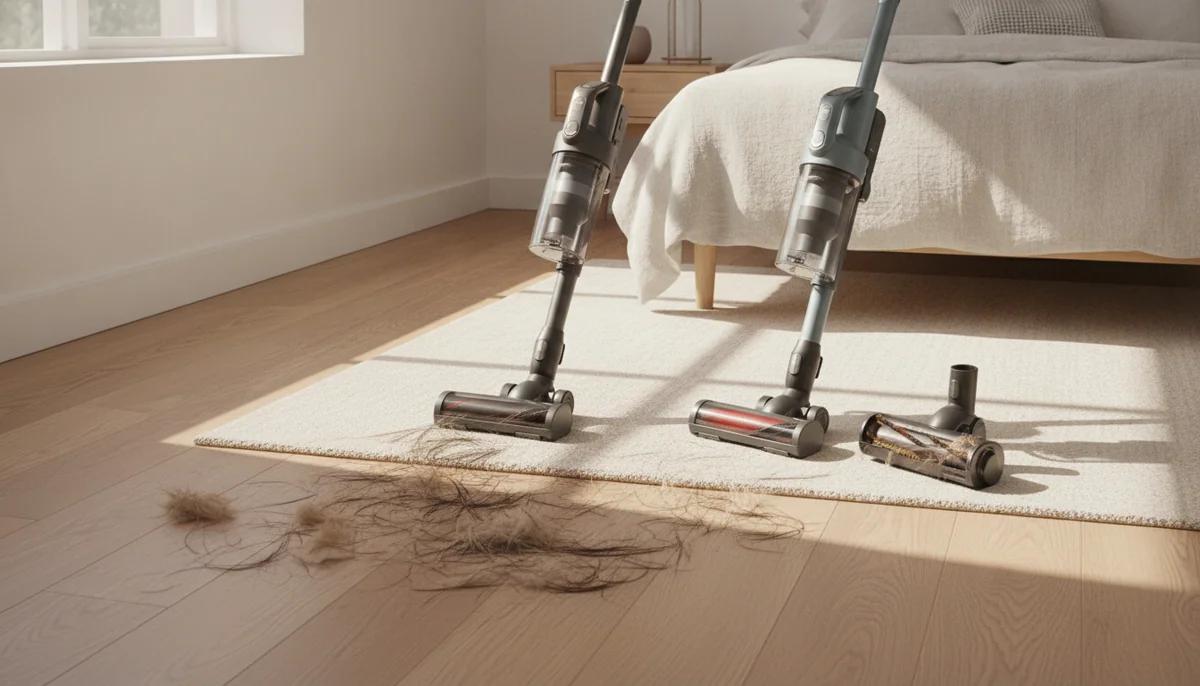
Hair wrap is not a mysterious vacuum disease. A rotating roller catches a strand, friction holds it against the surface, and every revolution winds it tighter. Enough hair forms a sleeve around the brush, hides the bristles and increases resistance. The old remedy is familiar: turn the head over, find the scissors and perform an unpleasant little haircut.
Anti-tangle heads interfere with that sequence. Combs scrape strands from the roller, angled bristles guide them toward the suction path, vanes lift them away, and conical rollers encourage hair to migrate off one end. The best versions work well enough to change ownership. The worst merely print “tangle-free” beside an ordinary removable roller and leave the buyer to discover that the supplied cutting tool is not decorative.
The claim is narrower than it sounds
A brush roll can resist wrapping while the vacuum still accumulates hair around its end caps, axles, front wheels, soft roller, comb, bin screen or airway. That is why two apparently conflicting owner reports can both be true. One person may go months without cutting the main roller, while another pulls a fur plug from the same machine after a few sessions. They are describing different places in the hair’s journey.
Shark’s PowerDetect IP3251 illustrates the distinction particularly well. Its principal anti-wrap roll performs strongly with long hair and pet fur, including in controlled pickup testing, but hair can collect at the front roller’s comb, around the small wheels and inside the transfer route to the self-emptying dock. The machine solves much of the classic brush-bar problem without making the entire debris path hair-proof.
Strand length matters too. Short pet fur often travels through a head readily because individual fibers have fewer opportunities to encircle the roller. Long human hair can loop around both the brush and itself, then tighten into a cord. A claim supported by a demonstration with loose dog fur does not automatically establish resistance to long hair, thread, yarn or carpet fibers.
What the different mechanisms actually do
| Design | Useful effect | Where hair can still collect |
|---|---|---|
| Fixed comb teeth | Continuously scrape strands from the rotating surface before a thick layer develops. | Hair may bunch against the comb or migrate toward the roller ends. |
| Angled or V-shaped bristles | Guide strands toward the center suction opening instead of letting them settle across the roller’s full width. | Long strands can still tighten around the core when airflow does not carry them away. |
| Hair-removal vanes | Lift wound strands from the brush as it rotates and expose them to the airway. | Dense clumps can lodge at an end cap, behind the roller or farther along the narrow air path. |
| Conical roller | Moves hair toward the narrow end, where it can leave the brush and enter the bin. | The mechanism works best on a small upholstery tool and does not enlarge the bin or prevent downstream clogs. |
| Removable ordinary roller | Does not necessarily prevent wrapping, but makes the eventual cleanup far easier. | The owner must still remove, cut or pull away the wound hair. |
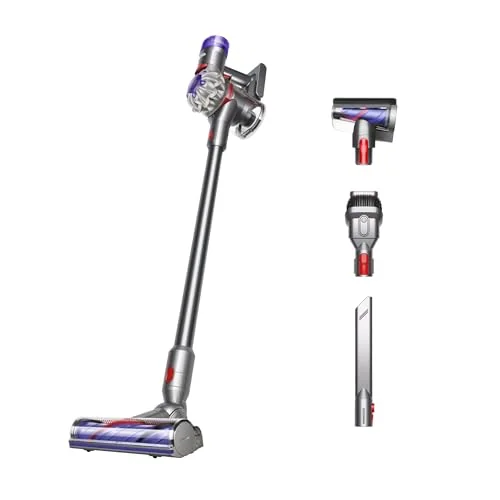
Dyson combines two approaches in the current V8 package. Hair-removal vanes clear the full-size Motorbar while the smaller Hair screw tool uses a conical brush for upholstery, pet beds and carpeted vehicle trim. Independent assessment and exact-package owner evidence support a meaningful reduction in wrapping, but hair can still collect at the roller ends and dense fur can overwhelm the V8’s small bin or narrow airway.
The best result in this group comes with a carpet warning
The Tikom V500 supplies the clearest evidence that anti-tangle engineering can be more than advertising. Its active comb produced nearly perfect resistance in a controlled test using 14-inch hair, and the roller remains removable for the cleanup that will eventually be necessary. That is a materially better result than simply including a groove where scissors can reach wound strands.
Hair resistance does not make the V500 the strongest vacuum here. The same independent assessment found below-average airflow and suction, with embedded-carpet performance trailing the tested cordless average. It is persuasive for daily fur, crumbs and dust on hard floors, rugs and low-pile carpet, but the anti-tangle result should not distract a carpet-heavy household from its limited deep-cleaning reserve.
The Shark IP3251 is the more ambitious mixed-floor option. It combines effective anti-wrap pickup with automatic surface response, sealed filtration and a dock that evacuates the onboard cup. That package can make frequent cleaning substantially easier, especially when pet fur is the mess that keeps forcing the vacuum out of storage.
The price of that convenience is complexity rather than immunity. The Shark is heavy, its filters still need regular attention, hair can lodge outside the principal roller, and the dock cannot always pull a compacted hair mass through the transfer route. It is an excellent example of a machine that reduces two recurring chores without abolishing either one.
A removable roller may beat a grander promise
The Eureka RapidClean Pro NEC280TL shows why the wording on the box is a poor buying test. It is marketed with a tangle-free brush roll and owners support its ability to collect loose pet hair, yet the retained record includes a professional cleaner who had to clear its small roller again soon after cleaning it. The label describes an intention, not a guaranteed outcome.
Another Eureka, the ReactiClean 410, makes the more defensible bargain visible: its roller comes out. Long-haired owners still report using scissors, but removal turns an awkward floorhead operation into a short bench-top task. Prevention is preferable when it works, yet easy access is more valuable than an unverified promise because access still helps after the promise fails.
When to reach for the scissors
Do not wait for the roller to stop. Inspect it when pickup falls, the motor pitch changes, the head becomes harder to push or the brush-roll warning appears. Switch the vacuum off, disconnect it from power, remove the battery when the design allows, and follow the manual before opening the floorhead.
Cut across the hair rather than along the roller, keeping the blade away from bristles, rubber fins, wiring and the roller surface. Pull the loosened sections out in small pieces, then inspect the end caps and wheels. A removable roller should be lifted out only through its intended release; forcing a sealed end can damage a bearing or compromise the head.
The interval is set by the home, not the marketing department. A short-haired pet on hard flooring may leave little to remove, while several long-haired people on carpet can challenge an excellent comb system. The practical win is not a forever-clean roller. It is checking occasionally and finding a few strands instead of cutting away a dense felted sleeve.
The verdict behind the label
Anti-tangle brush rolls are worth having, particularly in homes with long human hair or shedding pets. The strongest mechanisms can produce a large, observable reduction in wrapping, and the Tikom V500, Dyson V8 and Shark IP3251 each support that conclusion in a different way.
Cord Edge would not choose a vacuum on this feature alone. Floor pickup, carpet depth, filtration, runtime, handling, roller access and replacement parts still determine whether the whole machine suits the home. Treat anti-tangle performance as one important ownership advantage, then choose the vacuum whose honest limitation you can live with.
Frequently Asked Questions
Can an anti-tangle vacuum still wrap long human hair?
Yes, even an effective comb or vane system can leave long strands around the roller ends, axles or secondary moving parts.
Does a self-cleaning brush roll clean the entire vacuum head?
No, the term normally describes the main roller rather than the wheels, front roller, comb, end caps, bin screen or airway.
Is a removable brush roll the same as an anti-tangle brush roll?
No, removal makes wrapped hair easier to clear while a genuine anti-tangle mechanism attempts to prevent that hair from winding tightly in the first place.
Do anti-tangle rollers work equally well on pet fur and human hair?
No, short loose fur is generally easier to ingest than long strands that can loop around the roller and tighten with every revolution.
Can wrapped hair reduce vacuum performance?
Yes, accumulated hair can cover working bristles, increase drag and eventually interfere with pickup or roller movement.
How often should an anti-tangle brush roll be checked?
Inspect it whenever pickup changes or after demanding hair cleanup, then adjust the routine to the amount and length of hair in your home.
Which anti-tangle vacuum here has the strongest long-hair evidence?
The Tikom V500 has the clearest exact-model result because its comb achieved nearly perfect resistance in a controlled test using 14-inch hair.
Sources (5)
- Amazon listings and customer reviews
- Owner and reviewer video, 1 channel
- Techgearlab — Article — www.techgearlab.com
- Vacuumwars — Article — vacuumwars.com
- Rtings — Article — www.rtings.com